
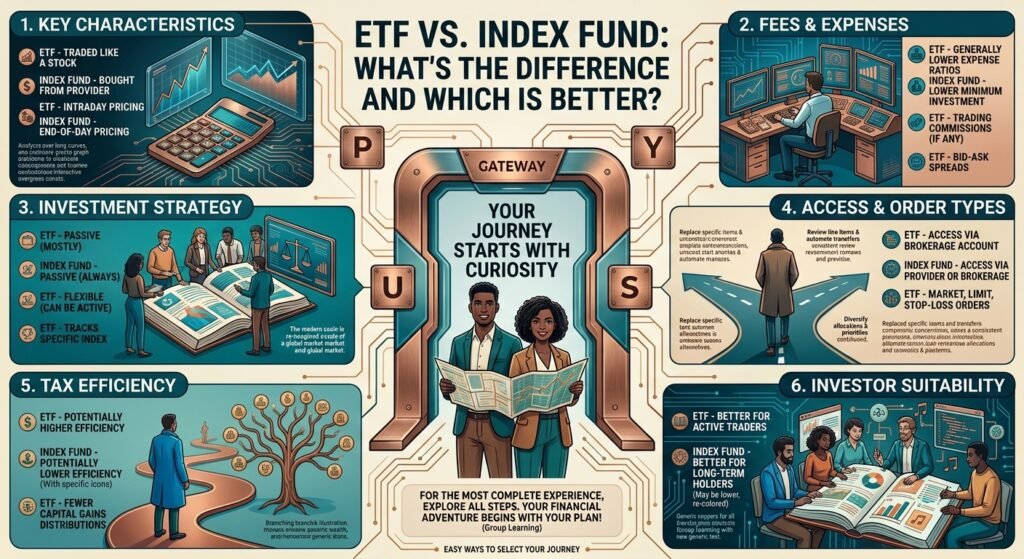
ETF vs. Index Fund: What’s the Difference and Which Is Better?
If you are beginning your investment journey, you have probably come across terms such as ETFs, index funds, mutual funds, stocks, and bonds. At first, these terms can seem complicated, especially when two investment options appear to do almost the same thing.
One of the most common questions beginners ask is: ETF vs. index fund—which is better?
The answer is not as simple as choosing one over the other. In fact, an important point to understand is that ETFs and index funds are not necessarily opposites. An ETF describes how a fund is structured and traded, while an index fund describes an investment strategy designed to track a particular market index. An index fund can be structured as an ETF or as a mutual fund.
For example, an investor could buy an S&P 500 index ETF or an S&P 500 index mutual fund. Both may seek to track the same index, but they can differ in how they are bought, sold, priced, and managed.
Understanding this distinction can make investing much easier.
In this Monezaro guide, we will explain the difference between ETFs and index funds, how each works, their advantages and disadvantages, costs, taxes, flexibility, and which option may make more sense for different types of investors.
Important: This article is for educational purposes only and is not personalized investment, tax, or financial advice. All investments involve risk, and you can lose money, including your original investment.
What Is an ETF?
ETF stands for Exchange-Traded Fund.
An ETF is a type of investment fund that holds a collection of assets, such as stocks, bonds, or other investments. Instead of buying every individual investment inside the fund separately, investors can purchase shares of the ETF.
For example, an ETF might hold hundreds of different companies. By buying one share of the ETF, you gain exposure to the fund’s portfolio rather than having to purchase each company individually.
The word “exchange-traded” is important because ETF shares trade on a stock exchange during regular market hours, similar to individual stocks.
This means the market price of an ETF can change throughout the trading day.
ETFs can follow many different strategies. Some track broad market indexes, while others focus on specific industries, countries, investment styles, bonds, commodities, or other areas.
This makes ETFs extremely flexible.
What Is an Index Fund?
An index fund is a fund designed to follow a particular market index.
Instead of trying to select individual investments that a manager believes will outperform the market, an index fund generally attempts to replicate the performance of its chosen index, before fees and other costs.
Common indexes include:
- S&P 500
- Nasdaq-100
- Dow Jones Industrial Average
- Russell 2000
- Total U.S. stock market indexes
- International stock market indexes
- Bond indexes
For example, an S&P 500 index fund seeks to provide exposure to companies represented in the S&P 500.
An index fund can be structured as either an ETF or a mutual fund.
This is one of the most important concepts to remember:
ETF = fund structure/trading format
Index fund = investment strategy
Therefore, comparing “ETF vs. index fund” is technically not always an apples-to-apples comparison.
A more accurate comparison for beginners is often:
Index ETF vs. index mutual fund.
ETF vs. Index Fund: The Basic Difference
The easiest way to understand the difference is to look at how each term is used.
An ETF tells you how the fund is traded.
An index fund tells you what strategy the fund follows.
An ETF may be an index fund, but not every ETF is an index fund. Some ETFs are actively managed.
Likewise, an index fund may be an ETF or a mutual fund.
This means that when someone asks whether ETFs or index funds are better, the answer depends on which specific funds they are comparing.
ETF vs. Index Fund Comparison
| Feature | Index ETF | Index Mutual Fund |
|---|---|---|
| Tracks an index | Usually | Usually |
| Trades during market hours | Yes | No |
| Price changes during the day | Yes | No |
| Purchased through brokerage | Yes | Yes |
| Diversification | Often high | Often high |
| Minimum investment | Can be relatively low | Depends on fund |
| Expense ratio | Often low | Can be low |
| Automatic investing | Usually available through brokers | Often straightforward |
| Intraday trading | Yes | No |
| Suitable for beginners | Yes | Yes |
The specific features, fees, minimums, and tax consequences vary by fund and brokerage.
1. How ETFs Work
When you purchase an ETF, you are buying shares that represent an interest in the fund.
For example, imagine an ETF designed to track a broad stock market index.
Instead of buying hundreds or thousands of individual stocks, you could buy shares of the ETF and gain exposure to the collection of investments held by that fund.
ETFs trade throughout the day on an exchange.
Suppose an ETF’s market price is $100 when the market opens. During the day, investors buy and sell the ETF, and its price may move to $101, $99, or another amount.
The price you receive depends on the market when your order executes.
This provides flexibility but also means investors need to understand basic trading concepts such as market orders and limit orders.
2. How Index Mutual Funds Work
An index mutual fund also pools money from many investors and uses that money to purchase a portfolio designed to track a specific index.
The major difference is how shares are priced and traded.
Mutual funds generally transact at their net asset value, or NAV, calculated according to the fund’s rules after the market closes.
Instead of watching the fund’s price move throughout the trading session, an investor places an order and receives the applicable NAV for the transaction.
This structure can work particularly well for investors who simply want to contribute money regularly and hold their investments for the long term.
3. ETFs Can Be Index Funds
This is where many beginners become confused.
An ETF is not automatically different from an index fund.
Consider a hypothetical fund called an “S&P 500 ETF.”
If that ETF is designed to track the S&P 500, it is both:
- An ETF
- An index fund
The same basic index-tracking strategy could also be offered through a mutual fund.
Therefore, the more useful question is often:
Should I buy an index ETF or an index mutual fund?
That comparison makes the differences much clearer.
4. Trading Flexibility
One of the biggest differences between ETFs and mutual funds is trading flexibility.
ETFs trade on exchanges throughout the trading day.
This means investors can generally buy or sell them while the market is open.
For example, if you want to purchase an ETF at a particular market price, you can place an order during trading hours.
Mutual funds work differently. Orders are generally processed at the fund’s applicable NAV rather than being continuously traded throughout the day.
For long-term investors, this difference may not matter much.
If your strategy is to invest regularly and hold your investments for decades, intraday price movements may be less important than costs, diversification, and maintaining a disciplined strategy.
5. Expense Ratios and Investment Costs
Costs matter because even small differences can affect long-term investment results.
An expense ratio represents the annual operating expenses charged by a fund, expressed as a percentage of assets.
For example, suppose a fund has an expense ratio of 0.10%.
That means the annual operating expenses are approximately 0.10% of the assets invested, although the actual amount paid by an investor depends on the fund’s assets and performance.
Many broad-market index funds and ETFs have relatively low expense ratios.
However, investors should not assume that every ETF is cheaper than every mutual fund.
The correct approach is to compare the actual funds you are considering.
Look at:
- Expense ratio
- Trading costs
- Bid-ask spread
- Account fees
- Minimum investment
- Other fund expenses
A fund with a slightly lower expense ratio is not automatically better if other costs or features make it less suitable for your needs.
6. Minimum Investment Requirements
Minimum investment requirements can vary significantly between funds.
Some ETFs allow investors to purchase a single share, although the actual amount needed depends on the ETF’s market price and whether the brokerage supports fractional shares.
Some mutual funds may have minimum initial investment requirements, while others have low or no minimums depending on the provider.
Fractional-share investing has also made it easier for some investors to invest smaller amounts into ETFs.
For beginners starting with $25, $50, or $100 at a time, checking whether their brokerage supports fractional ETF purchases can be useful.
7. Automatic Investing
Automatic investing can make it easier to build a long-term investment habit.
Many investors prefer to automatically transfer part of each paycheck into an investment account.
Mutual funds have traditionally been convenient for automatic investing because investors can specify a dollar amount and purchase fund shares according to the fund’s procedures.
Many modern brokerages also offer automatic ETF investing and fractional shares.
As a result, the gap between ETFs and mutual funds has become smaller for many investors.
The most important thing is not whether your investment is technically an ETF or mutual fund. What matters is whether the system makes it easy for you to invest consistently according to your long-term plan.
8. Diversification
Both ETFs and index mutual funds can provide significant diversification.
Instead of owning one company’s stock, you can invest in a fund holding many securities.
For example, a broad-market fund may provide exposure to companies across different industries.
Diversification can reduce the impact of a poor performance from any single company, although it cannot eliminate market risk.
It is important to understand that not every ETF or index fund is automatically well diversified.
A narrowly focused sector fund may hold companies from only one industry.
A fund focused on one country or asset class may also provide less diversification than a broad-market fund.
Always check what the fund actually owns.
9. Taxes and Tax Efficiency
Taxes are another important consideration for U.S. investors.
ETFs can have structural features that may make them tax-efficient in certain taxable-account situations, but tax treatment depends on the specific fund and circumstances.
Mutual funds can also be tax-efficient, especially when they are designed to track indexes, but investors should still consider potential capital-gains distributions.
Your tax situation may also differ depending on whether you hold investments in:
- A taxable brokerage account
- A traditional IRA
- A Roth IRA
- A 401(k)
- Another retirement or tax-advantaged account
Because tax rules can be complicated and can change, investors with significant tax considerations should consider consulting a qualified tax professional.
10. ETFs May Be Better for Investors Who Want Flexibility
An ETF may be attractive if you value the ability to trade during market hours.
ETFs can be useful for investors who want:
- Intraday trading
- Flexible order types
- Fractional-share investing where available
- Broad investment choices
- Potentially low expenses
- Easy access through brokerage accounts
However, flexibility can sometimes encourage unnecessary trading.
If you constantly check prices and buy or sell based on short-term market movements, the convenience of ETFs could work against a long-term strategy.
11. Index Mutual Funds May Be Better for Simple Long-Term Investing
Index mutual funds can be attractive for investors who want simplicity.
If your goal is to invest a fixed amount regularly and hold your investments for many years, you may not need intraday trading.
A mutual fund can provide a straightforward way to contribute money and maintain a diversified portfolio.
For some investors, simplicity is more valuable than trading flexibility.
The best investment is often the one you can consistently hold through market ups and downs.
12. Which Is Better for Beginners?
There is no universal winner.
For many beginners, both low-cost index ETFs and low-cost index mutual funds can be excellent building blocks for a diversified long-term portfolio.
The choice depends on factors such as:
- Your brokerage
- Investment amount
- Available funds
- Expense ratios
- Automatic investment options
- Tax situation
- Account type
- Desired flexibility
- Personal preferences
If you want maximum trading flexibility, an ETF may appeal to you.
If you want a simple recurring investment experience and do not care about intraday trading, an index mutual fund may be appealing.
13. ETF vs. Index Fund for Long-Term Investors
Long-term investors often have a different perspective than active traders.
If your investment horizon is 10, 20, or 30 years, daily price movements may be less important.
Instead, you may want to focus on:
- Diversification
- Low costs
- Consistent investing
- Appropriate risk
- Asset allocation
- Time horizon
- Tax considerations
- Avoiding emotional decisions
This is why a low-cost index ETF and a low-cost index mutual fund can both be reasonable choices.
The difference in trading structure may be less important than maintaining a disciplined long-term strategy.
14. ETF vs. Index Fund for Retirement Accounts
Investors can hold many types of investments in retirement accounts, depending on the plan or brokerage.
For example, an investor may encounter mutual funds in an employer-sponsored retirement plan such as a 401(k), while a brokerage IRA may offer both ETFs and mutual funds.
The investment options available depend on the specific retirement plan.
When investing for retirement, beginners should pay attention to:
- Investment costs
- Diversification
- Asset allocation
- Time horizon
- Risk tolerance
- Employer matching opportunities
- Account rules
The type of fund is only one part of the overall retirement strategy.
15. ETFs Are Not Always Safer Than Mutual Funds
A common misconception is that ETFs are automatically safer because they are diversified.
That is not necessarily true.
Risk depends primarily on what the fund owns.
A broad-market ETF holding hundreds of companies may be relatively diversified.
But an ETF focused on a single industry, country, commodity, or highly volatile asset can have significantly different risks.
The same principle applies to mutual funds.
Before investing, look beyond the label and examine the underlying holdings.
16. Index Funds Are Not Risk-Free
Another common misconception is that index funds cannot lose money.
They can.
If the market or index being tracked declines, the fund can decline as well.
For example, an index fund tracking a stock market index will generally experience market declines when the underlying stocks fall.
Diversification can reduce company-specific risk, but it cannot eliminate broad market risk.
Investors should therefore choose investments based on their financial goals, time horizon, and ability to tolerate losses.
17. What Should Beginners Look for in an ETF or Index Fund?
Instead of asking only whether an investment is an ETF or index fund, evaluate the fund itself.
Check the Expense Ratio
Lower costs can help preserve more of your investment returns over time.
Examine the Index
Understand what the fund is designed to track.
Review Holdings
Check whether the fund provides the level of diversification you want.
Look at Fund Size and Liquidity
Larger, actively traded funds may offer convenient trading, although fund size alone should not determine your decision.
Check the Tracking Difference
An index fund may not perfectly match its benchmark because of expenses, trading, taxes, and other factors.
Understand the Risk
Make sure the fund’s holdings fit your investment objectives.
Review Your Account
A fund that works well in one type of account may not necessarily be the best fit for another investor or account.
ETF vs. Index Fund: A Simple Example
Imagine two hypothetical investments:
Fund A: Broad-market index ETF
Fund B: Broad-market index mutual fund
Both track essentially the same market index.
Suppose both have similar:
- Holdings
- Expense ratios
- Historical tracking
- Diversification
The primary difference may be how investors buy and sell them.
Fund A trades throughout the day like a stock.
Fund B is priced according to its NAV under mutual-fund trading rules.
If you are investing $200 every month and plan to hold the investment for 25 years, the trading difference may not matter much.
If you actively want to trade during market hours, the ETF structure may be more useful.
This illustrates why the “better” choice depends on your investing style.
Common Mistakes Beginners Make
Choosing a Fund Only Because It Is an ETF
Being an ETF does not automatically make an investment good.
Always examine what the fund owns and what strategy it follows.
Ignoring Fees
A small annual expense difference can matter over a long investment period.
Chasing Past Performance
A fund that performed exceptionally well recently may not continue doing so.
Trading Too Frequently
Long-term investors can hurt their results by making emotional decisions based on short-term market movements.
Ignoring Diversification
A narrow ETF may not provide the diversification you expect.
Forgetting Taxes
Tax consequences can vary depending on the account and investment.
Investing Without an Emergency Fund
Investing money you may need for an unexpected expense can force you to sell investments at an unfavorable time.
ETF vs. Index Fund: Which One Should You Choose?
A simple decision framework can help.
Choose an Index ETF if:
- You want intraday trading flexibility.
- You prefer ETF-style investing.
- Your brokerage offers convenient fractional ETF investing.
- You want access to a wide range of ETF strategies.
- You are comfortable placing brokerage orders.
Consider an Index Mutual Fund if:
- You prefer simple long-term investing.
- You want to invest a specific dollar amount regularly.
- Your retirement plan offers low-cost index mutual funds.
- You do not need intraday trading.
- You prefer the traditional mutual-fund structure.
Consider Either if:
- You want diversified long-term investing.
- You are focused on low costs.
- You understand the underlying investments.
- You plan to invest consistently.
- The fund fits your goals and risk tolerance.
A Beginner’s ETF and Index Fund Checklist
Before investing, ask yourself:
- What index does this fund track?
- What does the fund actually own?
- How diversified is it?
- What is the expense ratio?
- Does my brokerage charge trading fees?
- Does the fund have a minimum investment?
- Does my brokerage offer fractional shares?
- Is automatic investing available?
- What are the tax implications?
- How much risk am I comfortable taking?
- How long do I plan to invest?
- Do I have an emergency fund?
- Am I investing money I can afford to leave invested?
These questions can help you make a more informed decision instead of choosing a fund simply because it is popular.
Final Thoughts
The ETF vs. index fund debate becomes much easier to understand once you recognize that these terms describe different things.
An ETF is a fund structure that trades on an exchange during market hours. An index fund is a fund designed to track a particular market index. An index fund can be structured as an ETF or as a mutual fund.
For many beginners, the most important factors are not simply whether the fund is an ETF or mutual fund. Instead, focus on cost, diversification, underlying holdings, investment strategy, taxes, account type, and whether you can consistently stick with the investment plan.
A low-cost, diversified index ETF can be a strong option for one investor, while a low-cost index mutual fund may be more convenient for another.
The best choice is generally the investment structure that fits your goals and makes it easier for you to maintain a disciplined long-term strategy.
At Monezaro, we believe that understanding basic investment concepts is an important step toward making more informed financial decisions. Before investing, take time to understand what you are buying, what risks you are taking, and how the investment fits into your broader financial plan.
Frequently Asked Questions
Is an ETF the same as an index fund?
No. An ETF describes a fund that trades on an exchange, while an index fund describes a fund designed to track a market index. An ETF can be an index fund, and an index fund can also be a mutual fund.
Are ETFs better than index funds?
Neither is automatically better. A low-cost index ETF and a low-cost index mutual fund can both be suitable for long-term investors. The right choice depends on your goals, account, costs, trading preferences, and available investment options.
Are index funds safer than ETFs?
Not necessarily. Risk depends primarily on the investments held by the fund. A diversified index ETF and diversified index mutual fund can have similar market exposure if they track the same index.
Do ETFs have lower fees than index funds?
Not always. Many ETFs have low expense ratios, but some mutual funds also have very low costs. Compare the actual expense ratio and other relevant costs rather than assuming one structure is always cheaper.
Can I invest in ETFs with $100?
Potentially, yes. The amount needed depends on the ETF’s share price and whether your brokerage supports fractional shares. Some brokerages allow investors to purchase fractional ETF shares.
Should beginners invest in ETFs?
ETFs can be appropriate for beginners when they understand the investment, risks, costs, and diversification. Broad-market, low-cost ETFs are commonly used by long-term investors, but no investment is guaranteed.
Can I lose money in an index fund?
Yes. Index funds can decline when the underlying market or investments decline. Diversification can reduce certain risks but does not eliminate the possibility of losses.
SEO Information
SEO Title: ETF vs. Index Fund: What’s the Difference and Which Is Better? | Monezaro
Meta Description: Learn the difference between ETFs and index funds, how they work, their costs, risks, taxes, and which investment option may be better for beginners and long-term investors.
Primary Keyword: ETF vs index fund
Secondary Keywords:
- ETF vs. index fund
- ETF vs index fund difference
- index fund vs ETF
- are ETFs better than index funds
- best index funds for beginners
- best ETFs for beginners
- investing for beginners
- index funds for beginners
- ETF investing for beginners
- how ETFs work
- how index funds work
- low-cost index funds
- low-cost ETFs
- passive investing
- long-term investing
- diversified investing
- stock market for beginners
Suggested URL: /etf-vs-index-fund/
Category: Investing
Tags: ETFs, Index Funds, Investing, Investing for Beginners, Personal Finance, Stock Market, Passive Investing, Wealth Building, Money Management
Search Intent: Informational / Commercial Investigation
Target Audience: U.S. beginners, young professionals, new investors, retirement savers, and anyone comparing ETFs and index funds.
Suggested Internal Links:
- Investing for Beginners: How to Start Investing With Little Money
- Personal Finance for Beginners
- How to Create a Monthly Budget That Actually Works
- How to Build an Emergency Fund
- Best Passive Income Ideas for Beginners in 2026
- How to Pay Off Debt Faster
- 50/30/20 Budget Rule Explained