
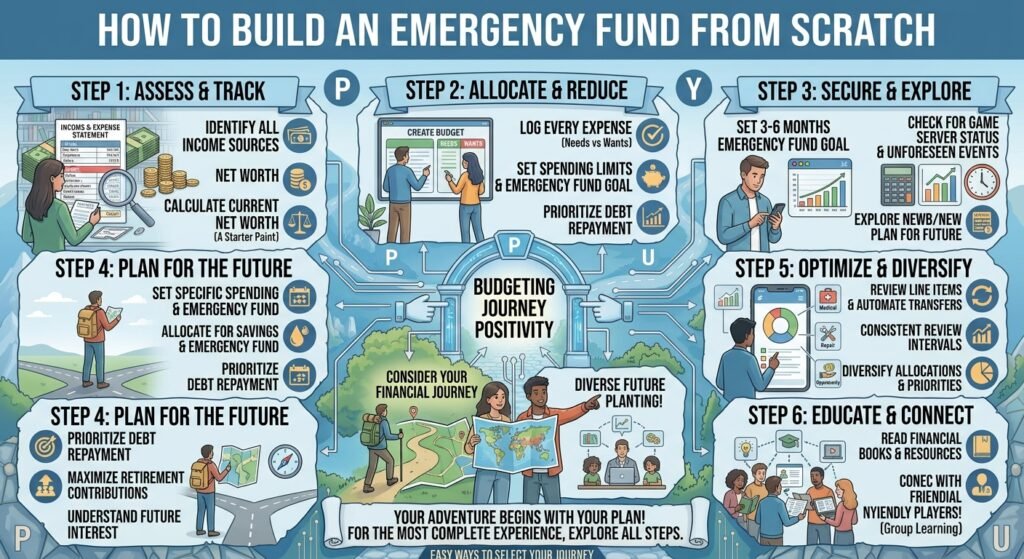
How to Build an Emergency Fund From Scratch
Unexpected expenses are a normal part of life. A car may suddenly need repairs, a medical bill may arrive, a major household appliance may stop working, or your income could temporarily decrease. Without savings, even a relatively small financial emergency can force you to rely on credit cards, loans, or money borrowed from family and friends.
This is where an emergency fund becomes one of the most important parts of a healthy financial plan.
An emergency fund is money set aside specifically for unexpected and necessary expenses. It gives you a financial cushion when something goes wrong and can help you avoid taking on expensive debt.
The good news is that you do not need thousands of dollars to start. You can build an emergency fund gradually, even if you are currently living on a tight budget. The key is to start with a realistic target, save consistently, and increase your savings as your financial situation improves.
In this guide, Monezaro explains how to build an emergency fund from scratch, how much you may need, where to keep it, and how to stay motivated while building your financial safety net.
What Is an Emergency Fund?
An emergency fund is a dedicated amount of money reserved for unexpected expenses that are necessary and difficult to predict.
For example, an emergency fund may help pay for:
- Unexpected car repairs
- Emergency medical expenses
- Essential home repairs
- Temporary loss of income
- Urgent travel caused by a family emergency
- Emergency insurance deductibles
- Essential appliance replacement
- Other unexpected necessary expenses
An emergency fund is different from money you save for a vacation, new phone, holiday shopping, or entertainment.
The purpose of emergency savings is protection. You are creating a financial buffer so that an unexpected event does not immediately become a financial crisis.
Why Is an Emergency Fund Important?
Without emergency savings, unexpected expenses often have to be paid using credit cards or personal loans.
This can create a cycle where one emergency leads to debt, and the debt then creates additional monthly payments and interest costs.
An emergency fund gives you another option.
For example, imagine your car suddenly requires a $1,000 repair. If you have $1,500 in emergency savings, you can potentially pay the bill without putting the entire expense on a credit card.
Afterward, you can rebuild the amount you used.
This financial cushion can also provide psychological benefits. Knowing that you have money available for genuine emergencies can make unexpected financial problems less stressful.
1. Start With a Small Emergency Fund Goal
One of the biggest mistakes beginners make is thinking they need to save three to six months of expenses immediately.
That can make emergency savings feel impossible.
Instead, start with a small target.
Your first goal might be:
- $500
- $1,000
- $1,500
- One month’s essential expenses
The right starting point depends on your income, expenses, debt, and financial responsibilities.
The most important thing is to create a goal that feels achievable.
If you can save $50 per week, reaching $500 would take about 10 weeks. Once you reach that first milestone, you can create a larger goal.
Building an emergency fund is a process rather than a one-time event.
2. Calculate Your Essential Monthly Expenses
Once you have your initial target, calculate how much money you actually need to cover your essential expenses.
Focus on necessities rather than lifestyle spending.
Your list might include:
- Rent or mortgage
- Utilities
- Groceries
- Transportation
- Insurance
- Minimum debt payments
- Essential healthcare expenses
- Basic household needs
You do not necessarily need to include restaurant meals, vacations, entertainment, luxury purchases, or other optional spending.
Understanding your essential monthly expenses helps you determine how large your emergency fund should eventually become.
For example, if your essential monthly expenses are approximately $3,000, then three months of essential expenses would equal about $9,000.
You do not have to reach that amount immediately.
3. Choose Your Emergency Fund Target
A common long-term goal is to have enough emergency savings to cover several months of essential living expenses.
However, the appropriate amount varies from person to person.
Someone with a stable job, two household incomes, and relatively low expenses may have different needs than someone with irregular income or a single source of income.
You could use a progression such as:
Stage 1: Save your first $500.
Stage 2: Increase savings to $1,000.
Stage 3: Build enough to cover one month of essential expenses.
Stage 4: Work toward several months of essential expenses.
This approach makes a large goal easier to manage.
Instead of constantly thinking about a $10,000 target, focus on the next milestone.
4. Create a Separate Savings Account
Keeping emergency savings separate from your everyday checking account can make it easier to avoid spending the money accidentally.
Consider using a dedicated savings account for your emergency fund.
The account should generally be easy enough to access when a genuine emergency occurs, while being separate from the account you use for everyday purchases.
For many people, an interest-bearing savings account can also allow the money to earn some interest while remaining accessible.
Before choosing an account, review its current terms, fees, withdrawal rules, minimum balance requirements, and interest rate.
The primary purpose of an emergency fund is safety and accessibility—not maximizing investment returns.
5. Decide How Much You Can Save Every Paycheck
You do not need to save a huge amount at once.
Choose an amount that fits comfortably within your current budget.
For example, you might start with:
- $25 per paycheck
- $50 per paycheck
- $100 per paycheck
- $200 per paycheck
The exact amount matters less than creating a consistent habit.
If you are paid twice per month and save $100 from each paycheck, you would put approximately $2,400 into savings over a year, assuming the contributions remain consistent.
As your income or financial situation improves, you can increase the amount.
6. Automate Your Emergency Fund Contributions
Automation can make saving significantly easier.
Instead of manually transferring money to savings every month, set up an automatic transfer from your checking account.
For example, if your paycheck arrives every two weeks, you could automatically transfer a predetermined amount into your emergency savings shortly after payday.
This creates a simple system:
Paycheck → Automatic savings → Remaining money for expenses
Automation reduces the temptation to spend the money first and save whatever remains.
You can also consider splitting your direct deposit if your employer and financial institution provide that option.
7. Review Your Monthly Budget
Building an emergency fund becomes much easier when you have a clear monthly budget.
Review your income and expenses and identify areas where you may be spending more than necessary.
Look for categories such as:
- Dining out
- Takeout
- Streaming subscriptions
- Online shopping
- Entertainment
- Unused memberships
- Expensive phone plans
- Convenience purchases
You do not need to eliminate everything you enjoy.
Instead, look for expenses that provide relatively little value compared with their cost.
If you find an extra $150 per month in your budget, that money could potentially go directly toward your emergency fund.
8. Cut One or Two Major Expenses
Small savings are useful, but major expenses can have an even larger impact.
Look at your biggest recurring costs and ask whether there are realistic ways to reduce them.
For example, you might:
- Negotiate certain service bills
- Compare insurance options
- Reduce unnecessary phone-plan features
- Move to a less expensive subscription plan
- Reduce transportation costs
- Prepare more meals at home
Be careful when changing financial products or insurance coverage. The cheapest option is not always the best option if it leaves you without important protection.
The goal is to reduce unnecessary costs while maintaining the essentials.
9. Use Extra Income to Build Your Emergency Fund
If your regular paycheck leaves little room for savings, consider directing temporary or additional income toward your emergency fund.
This might include:
- Freelance income
- Overtime pay
- Bonuses
- Selling unused items
- Side-business income
- Cash gifts
- Rebates
- Other legitimate extra income
You do not have to save 100% of additional income.
However, directing a meaningful portion toward emergency savings can accelerate your progress without requiring major changes to your normal lifestyle.
For example, if you earn an additional $400 from a side project and put $300 into your emergency fund, you can make significant progress without reducing your regular household budget.
10. Save Unexpected Money
Unexpected money can provide an excellent opportunity to grow your emergency fund.
Whenever you receive money that was not included in your normal spending plan, consider saving some or all of it.
For example, you might receive a work bonus or sell an old electronic device.
Instead of immediately spending the money, transfer it to your emergency savings account.
This can help you reach your target much faster.
It can also reduce the temptation to treat every unexpected dollar as spending money.
11. Make Saving Automatic After a Raise
A raise can improve your financial situation, but lifestyle inflation can quickly absorb the additional income.
Lifestyle inflation happens when spending increases as income increases.
For example, someone might receive a $500 monthly raise and quickly start spending most of that additional money on restaurants, shopping, subscriptions, or a more expensive lifestyle.
Instead, consider directing at least part of every future income increase toward savings.
If your monthly income increases by $500, you might decide to put $250 or another affordable amount into your emergency fund.
This allows your financial security to grow alongside your income.
12. Avoid Using Your Emergency Fund for Non-Emergencies
Building an emergency fund is only half the challenge. Protecting it is equally important.
Before withdrawing money, ask yourself:
Is this expense unexpected?
Is it necessary?
Could I reasonably pay for it from my regular budget?
A new gaming console, vacation, designer clothing, or routine entertainment purchase generally does not qualify as an emergency.
If you repeatedly use your emergency fund for planned purchases, you may never build a stable financial cushion.
For planned expenses, create separate sinking funds or savings categories.
13. Create Separate Savings for Planned Expenses
Not every large expense is an emergency.
Car insurance payments, annual memberships, holiday gifts, vacations, school expenses, and routine vehicle maintenance may be predictable even if they do not occur every month.
Instead of using your emergency fund for these expenses, create separate savings categories.
For example, if you expect a $1,200 annual expense, saving $100 per month can help you prepare for it.
This strategy protects your emergency fund while making irregular expenses easier to manage.
14. Rebuild Your Fund After Using It
Sometimes a genuine emergency will require you to use your savings.
That is exactly why the fund exists.
Do not feel like you failed because you had to withdraw money.
Instead, treat the withdrawal as a signal to begin rebuilding.
For example, suppose you have $5,000 saved and use $1,500 for an unexpected home repair. You now have $3,500 remaining.
Once the emergency has passed, temporarily increase your savings contributions if your budget allows.
Your new goal becomes rebuilding the missing $1,500.
Over time, this process can make your emergency fund stronger.
15. Increase Your Emergency Fund Over Time
Your financial situation will change.
Your rent may increase. Your family may grow. Your income may change. You may purchase a home, change jobs, or take on new financial responsibilities.
For this reason, your emergency fund should not be considered a permanent number.
Review your target periodically.
If your essential monthly expenses increase from $2,500 to $3,200, for example, you may eventually want to increase your emergency savings target as well.
The goal is to maintain a financial cushion that reflects your current circumstances.
How Much Should You Have in an Emergency Fund?
There is no universal emergency-fund amount that works for everyone.
A useful way to think about emergency savings is in stages.
Starter Emergency Fund
A starter fund of $500 to $1,000 can help cover smaller unexpected expenses.
One Month of Essential Expenses
Once you have your initial savings, consider building toward one month of essential living expenses.
Several Months of Essential Expenses
A larger long-term emergency fund can provide more protection against significant income disruptions or extended financial challenges.
The appropriate target depends on factors such as job stability, household income, monthly expenses, debt, dependents, insurance coverage, and access to other financial resources.
Where Should You Keep Your Emergency Fund?
An emergency fund should generally be kept somewhere that prioritizes safety and accessibility.
A dedicated savings account can be appropriate for many people.
Some people choose an interest-bearing savings account so that their emergency money can earn interest while remaining accessible.
The key characteristics to consider include:
- Easy access when needed
- Low risk
- Reasonable fees
- Competitive interest rate
- Appropriate account protections
- Clear withdrawal rules
An emergency fund is generally not intended to be invested aggressively in assets that can experience significant short-term price changes.
The purpose is to have reliable money available when you need it.
Emergency Fund vs. Regular Savings
Although both involve saving money, they serve different purposes.
Emergency savings are designed for unexpected and necessary expenses.
Regular savings can be used for planned financial goals.
For example:
| Emergency Fund | Regular Savings |
|---|---|
| Unexpected car repair | Vacation |
| Emergency medical expense | New laptop |
| Temporary income loss | Holiday gifts |
| Urgent home repair | Home improvement |
| Unexpected necessary expense | New furniture |
Keeping these goals separate can help prevent you from accidentally spending money that was intended for emergencies.
How to Build an Emergency Fund When You Have Debt
Having debt does not necessarily mean you should completely avoid emergency savings.
Without any emergency savings, an unexpected expense could force you to add even more debt.
A practical approach for many people is to build a small starter emergency fund while also working on high-interest debt.
Once you have a basic financial cushion, you can prioritize debt repayment according to your financial situation and interest rates while continuing to build savings.
The right balance depends on your income, debt costs, financial stability, and personal circumstances.
How to Stay Motivated While Saving
Saving money can become frustrating when your progress seems slow.
One way to stay motivated is to track milestones rather than focusing only on the final goal.
For example:
$100 saved → $250 → $500 → $1,000 → one month of expenses → larger emergency fund
You can also create a simple savings tracker and update it every time you make a contribution.
Seeing the balance grow can make saving feel more rewarding.
Remember that the purpose of emergency savings is not simply to watch an account balance increase. It is to create financial protection that you can rely on when life becomes unpredictable.
Emergency Fund Checklist
Use this checklist to get started:
- Calculate your essential monthly expenses.
- Choose a starter savings goal.
- Open or designate a separate savings account.
- Create a monthly savings amount.
- Automate your savings contributions.
- Review your monthly expenses.
- Cut unnecessary recurring costs.
- Save part of unexpected income.
- Avoid using emergency savings for planned purchases.
- Create separate savings for predictable expenses.
- Rebuild the fund after an emergency.
- Review your emergency fund target periodically.
Final Thoughts
Building an emergency fund from scratch may seem difficult, especially when you are starting with little or no savings. But you do not need to build your entire financial safety net in one month.
Start small.
Set your first target, automate a manageable contribution, reduce unnecessary expenses, and direct extra money toward your savings whenever possible.
Once you reach your first milestone, continue building.
The most important thing is to create a habit of keeping money available for the unexpected. Over time, your emergency fund can become one of the strongest foundations of your personal financial plan.
At Monezaro, we believe that financial security begins with simple, consistent habits. An emergency fund may not seem exciting, but having money available when something unexpected happens can provide valuable financial flexibility and peace of mind.
Frequently Asked Questions
How much should I put in an emergency fund first?
A starter goal of $500 to $1,000 can be a practical beginning for many people. After reaching that amount, consider gradually building toward one month or several months of essential expenses based on your circumstances.
How can I build an emergency fund with no money?
Start with a very small amount, even $5 or $10 per paycheck. Review your expenses for opportunities to save, cancel unused subscriptions, sell unwanted items, and consider additional income opportunities. The goal is to establish the habit and increase contributions over time.
Should I invest my emergency fund?
Emergency funds are generally intended to be safe and accessible rather than exposed to significant investment risk. A suitable savings account may be more appropriate for emergency money than investments that can fluctuate substantially in value.
Can I use my emergency fund for debt payments?
It depends on your situation. Completely draining your emergency fund to pay debt could leave you vulnerable to taking on new debt if an unexpected expense occurs. Consider maintaining an appropriate cash cushion while developing a debt-repayment strategy.
What if I have to use my emergency fund?
Using your emergency fund for a genuine emergency is exactly what it is designed for. Once the situation is resolved, make rebuilding the fund your next financial priority.
How long does it take to build an emergency fund?
The timeline depends on your income, expenses, savings rate, and target. Someone who saves $250 per month will reach $1,000 in approximately four months, while someone saving $100 per month would need about ten months.
SEO Information
SEO Title: How to Build an Emergency Fund From Scratch: A Complete Guide | Monezaro
Meta Description: Learn how to build an emergency fund from scratch with simple steps. Discover how much to save, where to keep emergency savings, and how to reach your financial goals.
Primary Keyword: how to build an emergency fund
Secondary Keywords:
- emergency fund
- how to start an emergency fund
- emergency savings
- how much should I save for emergencies
- emergency fund for beginners
- how to save money
- financial emergency fund
- emergency savings account
- personal finance tips
- money management
- how to build savings
- saving money for beginners
- financial security
- emergency fund calculator
Suggested URL Slug: /how-to-build-an-emergency-fund/
Category: Saving Money
Tags: Emergency Fund, Saving Money, Personal Finance, Budgeting, Money Management, Financial Planning, Savings Tips
Search Intent: Informational
Target Audience: U.S. adults, young professionals, families, beginners, and anyone who wants to create financial protection against unexpected expenses.
Suggested Internal Links:
- Personal Finance for Beginners: A Complete Guide to Managing Your Money
- How to Create a Monthly Budget That Actually Works
- How to Save Money Fast: 15 Simple Strategies That Work
- How to Pay Off Debt Faster: Smart Strategies to Become Debt-Free
- Investing for Beginners: How to Start Investing With Little Money