
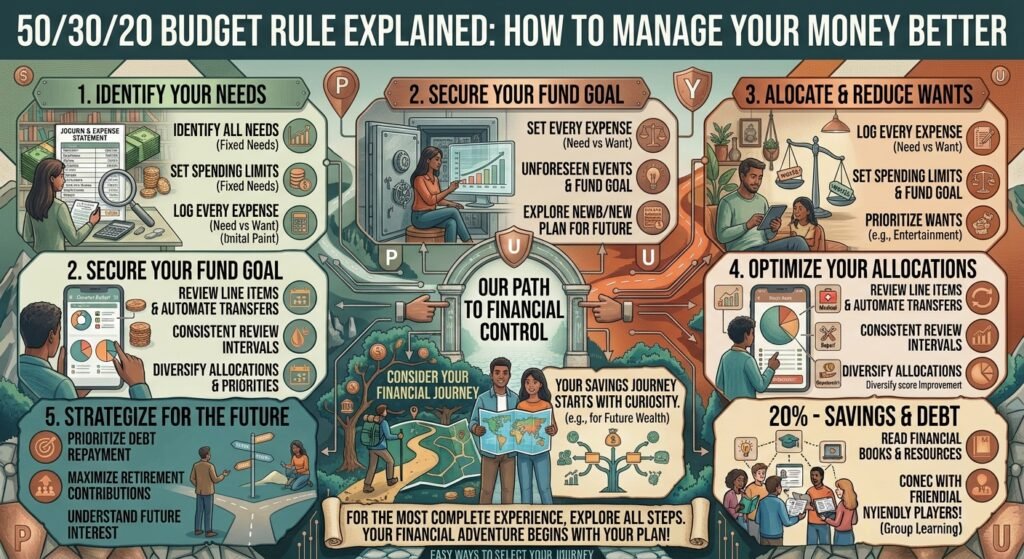
50/30/20 Budget Rule Explained: How to Manage Your Money Better
Managing money can feel complicated when you have rent, groceries, bills, debt payments, savings goals, and everyday expenses competing for the same paycheck. Without a clear system, it can be difficult to know how much you should spend, save, or use toward financial goals. The 50/30/20 budget rule offers a simple framework that can help you organize your money without requiring a complicated spreadsheet or dozens of spending categories.
The basic idea is straightforward: use approximately 50% of your after-tax income for needs, 30% for wants, and 20% for savings and debt repayment. These percentages are guidelines rather than strict rules. Your actual budget may need to look different depending on your income, housing costs, debt, family situation, location, and financial goals.
For someone just beginning to manage money, the 50/30/20 rule can provide a useful starting point. It helps create a balance between paying for today’s necessities, enjoying some of your income, and preparing for the future.
At Monezaro, we believe good money management should be practical and easy to understand. In this guide, you’ll learn exactly how the 50/30/20 budget rule works, how to calculate each category, how to adjust it for a low income or high-cost area, common mistakes to avoid, and how to use the rule as part of a long-term financial plan.
What Is the 50/30/20 Budget Rule?
The 50/30/20 budget rule divides your after-tax income into three major categories:
- 50% for needs
- 30% for wants
- 20% for savings and debt repayment
The purpose is to create a simple structure for your money.
Instead of tracking every individual purchase as a separate financial goal, you first determine which major category the expense belongs to.
For example, if your monthly take-home income is $5,000, the traditional framework would look like this:
- $2,500 for needs
- $1,500 for wants
- $1,000 for savings and debt repayment
This does not mean you have to spend exactly these amounts every month. It is a guideline designed to help you understand whether your spending is reasonably balanced.
If your essential expenses consume 65% of your income, for example, trying to force them down to exactly 50% may not be realistic. Instead, you can adjust the percentages while continuing to prioritize essential expenses, savings, and debt repayment.
Why Is the 50/30/20 Rule Popular?
One reason the 50/30/20 budget method is popular is its simplicity.
Many people abandon budgeting because they create plans with too many categories and complicated calculations. A budget may contain separate categories for restaurants, entertainment, clothing, subscriptions, groceries, transportation, utilities, travel, hobbies, gifts, and dozens of other expenses.
Detailed budgeting can be useful, but it is not necessary for everyone.
The 50/30/20 method gives you three broad categories that are easy to understand.
It can also encourage balance.
A budget should not necessarily mean eliminating every enjoyable expense. The 30% wants category recognizes that entertainment, hobbies, dining out, vacations, and other discretionary spending can have a place in a healthy financial plan.
At the same time, the 20% savings and debt category encourages you to think about your future instead of spending your entire paycheck today.
How the 50/30/20 Rule Works
Let’s look at each category in detail.
1. 50% for Needs
The first category is essential expenses.
Needs are costs you generally have to pay to maintain your basic lifestyle and financial obligations.
Common examples include:
- Rent or mortgage
- Utilities
- Groceries
- Basic transportation
- Health insurance
- Auto insurance
- Minimum debt payments
- Essential medical expenses
- Basic phone service
- Necessary household expenses
- Childcare required for work
The important distinction is between something you need and something you simply prefer.
For example, basic transportation may be a need if you rely on a vehicle to get to work. However, an expensive luxury vehicle with a large monthly payment may be a want rather than a need.
Similarly, groceries are generally a need, while frequent restaurant meals may belong in the wants category.
The goal is not to make these categories perfect. The goal is to become more aware of where your money is going.
2. 30% for Wants
The second category covers things you enjoy but could theoretically live without.
Examples include:
- Restaurant meals
- Takeout
- Streaming services
- Entertainment
- Hobbies
- Vacations
- Shopping
- New electronics
- Premium subscriptions
- Concerts
- Recreational activities
- Nonessential upgrades
This category is important because an overly restrictive budget can be difficult to maintain.
If you tell yourself that you will never eat at a restaurant, buy new clothes, travel, or enjoy entertainment again, you may eventually become frustrated and abandon your budget.
The wants category gives you room to enjoy your income while still maintaining financial discipline.
However, 30% is not a target you must spend.
If you enjoy spending less than 30% on wants, you can redirect the extra money toward savings, investments, or debt repayment.
3. 20% for Savings and Debt Repayment
The final category is focused on your financial future.
This 20% can potentially include:
- Emergency fund contributions
- Retirement savings
- Investments
- Extra debt payments
- Short-term savings
- Down payment savings
- Other financial goals
This category is particularly important because financial progress often requires money to be intentionally set aside before it gets spent elsewhere.
For example, if your monthly take-home income is $4,000, approximately $800 would be allocated to savings and debt repayment under the traditional framework.
You might divide that $800 between an emergency fund, retirement savings, and extra payments toward high-interest debt.
The exact split depends on your financial situation.
How to Calculate the 50/30/20 Budget
Calculating your budget is simple.
Start with your monthly after-tax income, sometimes called take-home pay.
Do not use your gross salary if you are trying to determine how much money is actually available for monthly spending.
For example, suppose your annual salary is $72,000, but taxes and other payroll deductions reduce your take-home income to $5,000 per month.
Your 50/30/20 budget would be based on the $5,000 you actually receive.
The calculation would be:
Needs: $5,000 × 50% = $2,500
Wants: $5,000 × 30% = $1,500
Savings and debt: $5,000 × 20% = $1,000
This gives you a basic monthly framework.
50/30/20 Budget Example for $3,000 Monthly Income
Suppose your monthly take-home income is $3,000.
Your target allocation would be:
| Category | Percentage | Monthly Amount |
|---|---|---|
| Needs | 50% | $1,500 |
| Wants | 30% | $900 |
| Savings & Debt | 20% | $600 |
| Total | 100% | $3,000 |
The $1,500 needs category could include housing, groceries, utilities, transportation, insurance, and minimum debt payments.
The $900 wants category could cover entertainment, dining out, hobbies, shopping, and subscriptions.
The remaining $600 could be directed toward emergency savings, retirement, investments, or additional debt payments.
50/30/20 Budget Example for $5,000 Monthly Income
Now imagine your monthly take-home income is $5,000.
The traditional allocation would be:
| Category | Percentage | Monthly Amount |
|---|---|---|
| Needs | 50% | $2,500 |
| Wants | 30% | $1,500 |
| Savings & Debt | 20% | $1,000 |
| Total | 100% | $5,000 |
This gives you a clear starting point for creating your monthly budget.
However, your actual expenses may not match these percentages.
If your rent alone is $2,000, you may have difficulty keeping all needs below $2,500.
That does not mean your budget has failed.
It means you need to adapt the framework to your circumstances.
Step 1: Calculate Your Take-Home Income
Before dividing your money into categories, determine how much money you actually receive.
Include:
- Salary
- Wages
- Self-employment income
- Reliable side income
- Other predictable income
If your income changes from month to month, consider using an average based on several recent months.
When income is unpredictable, it is generally safer to create your core budget around a conservative income estimate rather than your best month.
This reduces the risk of spending money you may not actually receive.
Step 2: List Your Essential Expenses
Write down your necessary monthly expenses.
Start with housing, utilities, groceries, transportation, insurance, healthcare, and minimum debt payments.
Do not worry about the 50% target yet.
First, find out what your actual needs cost.
Once you have the total, compare it with your take-home income.
This tells you whether the traditional 50% allocation is realistic for your situation.
Step 3: Separate Wants From Needs
This is one of the most useful parts of the 50/30/20 method.
Ask yourself a simple question:
“Could I reasonably live without this expense?”
If the answer is yes, it may belong in the wants category.
For example, basic groceries are a need, while ordering food delivery several times a week is usually a want.
A basic phone plan may be a need, while paying extra for the latest premium device may be a want.
The goal is not to judge your spending.
The goal is to understand it.
Step 4: Set Savings and Debt Goals
Once your needs and wants are identified, determine how to use the 20% category.
If you have no emergency savings, building an emergency fund may be an important priority.
If you have expensive credit card debt, additional debt repayment may deserve more attention.
If your emergency savings and high-interest debt are under control, you may focus more heavily on retirement savings or long-term investing.
You can divide the 20% according to your priorities.
Step 5: Automate Your Savings
One of the easiest ways to make the 50/30/20 rule work is to automate the savings portion.
Instead of waiting until the end of the month to see what remains, transfer your planned savings shortly after receiving your paycheck.
For example, if your target is $800 per month, you could automatically transfer $400 from each of two monthly paychecks into your savings or investment accounts.
Automation removes some of the temptation to spend the money first.
Step 6: Review Your Budget Every Month
A budget is not something you create once and forget.
Your financial situation can change.
Rent may increase. Your income may change. Insurance premiums may rise. You may pay off a loan or begin saving for a major purchase.
Review your spending at least once each month.
Ask:
- Did I stay close to my needs target?
- Did I overspend on wants?
- Did I save or repay debt as planned?
- Which expenses increased?
- Which expenses can be reduced?
- Do I need to change my goals?
This monthly review keeps your budget connected to your real life.
What If Your Needs Are More Than 50%?
This is extremely common, particularly in expensive cities or households with limited income.
If your essential expenses are 60% or 70% of your take-home income, do not assume that you are automatically bad at managing money.
Housing, childcare, healthcare, transportation, and other necessary costs can vary significantly between households.
Instead, look for areas where you have control.
You might reduce wants from 30% to 15% and increase savings or debt payments when possible.
For example:
- 60% needs
- 15% wants
- 25% savings/debt
This is still a useful budget.
The percentages are a framework, not a law.
Can You Use the 50/30/20 Rule on a Low Income?
Yes, but you may need to modify it.
When income is limited, essential expenses can consume most of your paycheck.
For someone earning $2,500 per month after taxes, allocating exactly $1,250 to needs may not be realistic depending on housing and other unavoidable costs.
In this situation, the first priority should be covering essential expenses and avoiding additional high-cost debt.
You can start with a smaller savings percentage if necessary.
Even saving $25 or $50 consistently can help establish the habit.
As your income increases, you can gradually increase the amount going toward savings and debt repayment.
How to Use the 50/30/20 Rule With Debt
Debt can make budgeting more complicated.
Minimum debt payments generally belong in the needs category because they are required financial obligations.
Extra debt payments can be included in the savings/debt category.
For example, suppose your monthly take-home income is $4,000.
You might allocate:
- $2,000 to needs
- $800 to wants
- $1,200 to savings and debt
The additional $400 beyond the traditional 20% could be directed toward high-interest credit card debt if becoming debt-free is a major priority.
You do not have to follow the rule exactly.
If eliminating high-interest debt is your priority, temporarily allocating more than 20% toward debt can make sense.
How to Use the Rule for an Emergency Fund
An emergency fund can help protect you from unexpected expenses.
Your 20% category can be used to gradually build emergency savings.
For example, if your take-home income is $4,500, the traditional savings allocation would be $900 per month.
You could direct a portion of that amount toward an emergency fund until you reach an appropriate target.
Once your emergency savings is established, you could redirect the money toward retirement contributions, investments, or other financial goals.
The important thing is to give your savings a specific purpose.
How to Use the Rule for Retirement
Retirement savings can also fit into the 20% category.
Depending on your employment situation, you may have access to an employer-sponsored retirement plan such as a 401(k).
If your employer offers matching contributions, understand the plan rules and eligibility requirements so you can make informed decisions about your contributions.
You may also have access to individual retirement accounts or other investment options.
The appropriate retirement strategy depends on your income, age, tax situation, employer benefits, goals, and other circumstances.
The 50/30/20 rule simply provides a framework for making retirement savings part of your regular budget.
How to Use the Rule for Investing
Long-term investing can also be included in your financial plan.
Once you have appropriate emergency savings and have considered your high-interest debt, you can direct some of your future-oriented money toward investments.
For example, someone following a modified 50/30/20 budget might allocate part of the 20% category to retirement accounts and part to long-term investments.
Investing involves risk, and investments can lose value. Your investment choices should reflect your time horizon, financial goals, and ability to tolerate losses.
The goal of budgeting is not to guarantee investment returns. It is to create room in your finances for long-term financial goals.
50/30/20 Rule vs. Zero-Based Budgeting
The 50/30/20 rule and zero-based budgeting approach money differently.
The 50/30/20 method focuses on broad percentages.
Zero-based budgeting assigns every dollar of income a specific purpose.
For example, if you earn $4,000, you might assign all $4,000 to housing, food, transportation, savings, debt, entertainment, and other categories until there is no unassigned money remaining.
Neither system is automatically better.
The 50/30/20 method can be easier for beginners because it requires fewer categories.
Zero-based budgeting can provide more control for people who want detailed tracking.
You can even combine them by using 50/30/20 as your overall framework and a detailed budget for individual categories.
Common Mistakes When Using the 50/30/20 Rule
Mistake 1: Treating the Percentages as Strict Rules
The biggest mistake is believing that every household must fit perfectly into 50/30/20.
Real life does not work that way.
Your budget should reflect your circumstances.
Mistake 2: Spending the Entire 30% on Wants
The 30% category is a maximum guideline, not necessarily a spending target.
If you only spend 15% on wants, you can direct the remaining money toward savings or debt.
Mistake 3: Ignoring High-Interest Debt
Saving money while carrying expensive credit card debt can require careful prioritization.
If your debt has a very high interest rate, paying it down may be an important part of your financial strategy.
Mistake 4: Forgetting Irregular Expenses
Some expenses do not arrive every month.
Examples include:
- Car repairs
- Insurance premiums
- Annual memberships
- Holiday spending
- Property taxes
- Medical expenses
- Home maintenance
Create sinking funds or separate savings categories for predictable irregular expenses so they do not destroy your monthly budget.
Mistake 5: Using Credit Cards to Fund Wants
If your wants category is $600 but you spend $900 by using a credit card, your budget is not actually working.
Credit should not be used to hide overspending.
If your spending consistently exceeds your budget, adjust your lifestyle or revise your plan based on your actual income and priorities.
How to Make the 50/30/20 Rule Work Better
The rule becomes more useful when you treat it as a flexible financial framework.
Here are several ways to improve it.
Automate savings
Set up automatic transfers so that saving happens before discretionary spending.
Review subscriptions
Cancel services you rarely use and redirect the savings toward financial goals.
Control lifestyle inflation
When your income increases, avoid automatically increasing every expense.
Prioritize high-interest debt
Consider directing additional money toward expensive debt.
Increase savings over time
If your income grows, gradually increase your savings rate.
Use separate accounts
Keeping emergency savings separate from everyday spending can make it easier to avoid accidentally using the money.
Track your progress
Monitor debt balances, savings balances, and other financial milestones.
A Modified 50/30/20 Budget Example
Suppose you earn $6,000 per month after taxes.
The traditional framework would be:
- $3,000 needs
- $1,800 wants
- $1,200 savings/debt
But imagine your essential expenses are $3,600.
Instead of forcing yourself to fit into the traditional model, you might create a modified budget:
- 60% needs = $3,600
- 15% wants = $900
- 25% savings/debt = $1,500
This budget reflects your actual situation while still maintaining a strong focus on financial progress.
The important lesson is that a budget should help you manage your money, not make you feel guilty because your life does not fit a predetermined formula.
50/30/20 Budget Checklist
Use this checklist when creating your monthly budget:
- Calculate your after-tax income
- List essential monthly expenses
- Calculate your wants
- Calculate your savings and debt payments
- Compare your numbers with 50/30/20
- Identify areas where you overspend
- Reduce unnecessary expenses
- Set an emergency savings goal
- Create a debt repayment strategy
- Automate savings
- Review your budget every month
- Adjust percentages when your circumstances change
- Increase savings when your income rises
- Track long-term financial progress
Final Thoughts
The 50/30/20 budget rule is a simple way to organize your money and create a healthier relationship with spending. By dividing your after-tax income into needs, wants, and savings or debt repayment, you can create a financial structure without tracking every purchase in excessive detail.
The traditional framework suggests spending 50% on needs, 30% on wants, and 20% on savings and debt. However, these percentages should be treated as guidelines rather than strict requirements.
Your housing costs, income, family responsibilities, debt, and financial goals may require a different approach. Someone with high living expenses may need to spend more than 50% on needs, while someone with a higher income may be able to save substantially more than 20%.
The most important goal is to make sure your money has a purpose.
Cover your essential expenses, control discretionary spending, save consistently, and work toward reducing expensive debt. As your financial situation improves, increase the amount you save and invest.
A good budget is not about restricting your life. It is about giving your money direction so that you can enjoy today while preparing for tomorrow.
At Monezaro, we believe effective money management starts with simple systems that you can actually maintain. The 50/30/20 rule can be an excellent starting point for building those habits and creating a clearer path toward financial stability.
Frequently Asked Questions
What is the 50/30/20 budget rule?
The 50/30/20 budget rule is a budgeting framework that suggests allocating approximately 50% of after-tax income to needs, 30% to wants, and 20% to savings and debt repayment.
Is the 50/30/20 rule realistic?
It can be a useful starting point, but it does not work perfectly for every household. Housing costs, income, debt, family size, location, and other factors can require different percentages.
Does the 50/30/20 rule include debt payments?
Minimum required debt payments are generally treated as needs, while additional debt payments can be included in the savings and debt category.
What if I cannot save 20% of my income?
Start with what you can afford. Even a small, consistent amount can help establish a savings habit. As your income increases or expenses decrease, you can gradually increase your savings rate.
Can I save more than 20%?
Yes. The 20% figure is a guideline, not a maximum. If your financial situation allows you to save more, you can increase your emergency savings, retirement contributions, investments, or debt payments.
Is the 50/30/20 rule based on gross or net income?
The framework is generally applied to after-tax income, meaning the money you actually take home after taxes and other payroll deductions.
Should emergency savings be included in the 20%?
Yes. Emergency fund contributions can be included in the savings portion of the framework.
Can I use the 50/30/20 rule if I have a lot of debt?
Yes. You can use the framework as a starting point while adjusting the percentages to prioritize high-interest debt. You may temporarily allocate more than 20% toward debt repayment if your budget allows.
What counts as a “want” in the 50/30/20 rule?
Wants are discretionary expenses that improve your lifestyle but are not essential for basic living. Examples include dining out, entertainment, vacations, hobbies, subscriptions, and nonessential shopping.
What is the biggest benefit of the 50/30/20 rule?
Its biggest advantage is simplicity. It gives beginners an easy framework for balancing essential expenses, discretionary spending, savings, and debt repayment without requiring an extremely detailed budget.
SEO Information
SEO Title: 50/30/20 Budget Rule Explained: How to Manage Your Money Better | Monezaro
Meta Description: Learn how the 50/30/20 budget rule works and how to use it to manage money, control spending, pay off debt, build savings, and reach financial goals.
Primary Keyword: 50/30/20 budget rule
Secondary Keywords:
- 50/30/20 budget
- 50/30/20 rule explained
- how to use the 50/30/20 rule
- budgeting for beginners
- monthly budget
- how to manage money
- money management
- personal finance
- budget rule
- 50 30 20 budgeting method
- how to create a budget
- how to save money
- debt repayment
- emergency fund
- financial planning
- saving money tips
Suggested URL Slug: /50-30-20-budget-rule/
Category: Budgeting
Tags: 50/30/20 Budget Rule, Budgeting, Personal Finance, Money Management, Saving Money, Debt Management, Financial Planning, Budgeting Tips
Search Intent: Informational
Target Audience: U.S. adults, beginners, young professionals, families, students, and anyone looking for a simple way to organize their monthly finances.
Suggested Internal Links:
- Personal Finance for Beginners: A Complete Guide to Managing Your Money
- How to Create a Monthly Budget That Actually Works
- How to Save Money Fast: 15 Simple Strategies That Work
- How to Build an Emergency Fund From Scratch
- How to Build Credit From Scratch and Improve Your Credit Score
- How to Pay Off Debt Faster: Smart Strategies to Become Debt-Free
- Investing for Beginners: How to Start Investing With Little Money