
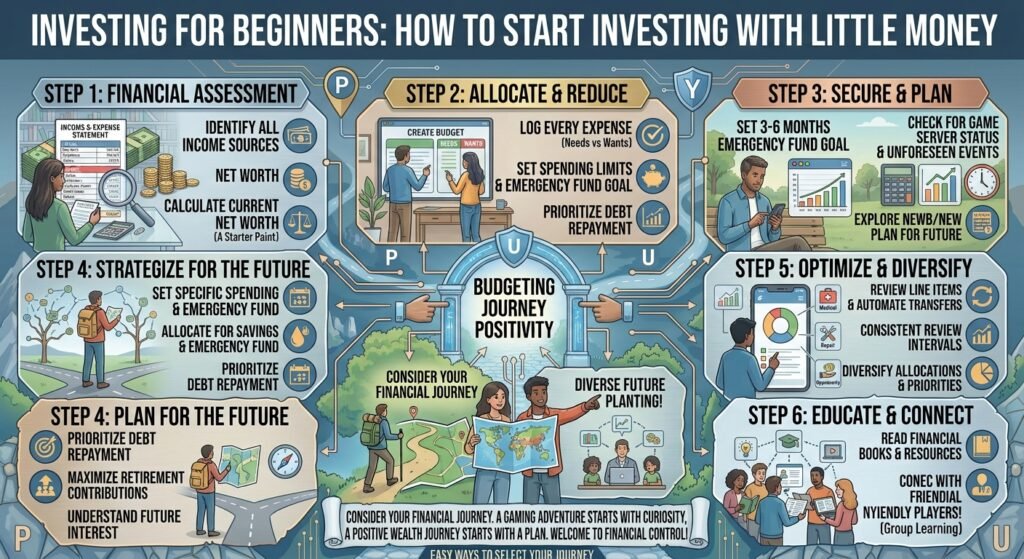
Investing for Beginners: How to Start Investing With Little Money
Investing can seem intimidating when you are just starting out. You may believe that you need thousands of dollars, advanced financial knowledge, or a high-paying job before you can begin investing. In reality, many people can start investing with relatively small amounts of money and gradually build their portfolios over time.
The most important part of investing is not starting with a large amount. It is developing good financial habits, understanding the basics, choosing investments that match your goals and risk tolerance, and giving your money enough time to potentially grow.
Whether you have $50, $100, or a few hundred dollars available to invest, getting started early can be more valuable than waiting until you feel completely ready.
In this beginner-friendly guide, Monezaro explains how investing works, how to start investing with little money, which investment options beginners should understand, and how to avoid common mistakes.
Important: This article is for educational purposes only and is not individualized financial, tax, or investment advice. Investments can lose value, and past performance does not guarantee future results.
What Is Investing?
Investing means putting money into an asset with the expectation that it may increase in value or generate income over time.
Common investments include:
- Stocks
- Bonds
- Exchange-traded funds (ETFs)
- Mutual funds
- Index funds
- Real estate
- Retirement accounts
- Other investment assets
Unlike keeping money in a regular checking account, investing involves risk. The value of many investments can rise and fall, sometimes significantly.
The reason people accept this risk is the potential for long-term growth.
For example, instead of keeping all of your long-term savings in cash, you might invest some money in a diversified portfolio designed for your goals and time horizon.
The right investment strategy depends on factors such as your goals, time horizon, income, financial situation, and ability to tolerate losses.
Why Should Beginners Start Investing?
Saving money is important, but investing can play an important role in long-term wealth building.
Inflation can reduce the purchasing power of money over time. Investing provides an opportunity for your money to potentially grow faster than it might in a traditional savings account, although that growth is never guaranteed.
Starting early can also give your investments more time to benefit from compounding.
For example, imagine two people invest similar amounts of money, but one starts many years earlier. The earlier investor may have more time for investment returns to potentially generate additional returns.
This is one reason time can be one of an investor’s most valuable resources.
1. Build a Financial Foundation First
Before investing, make sure your basic financial foundation is reasonably stable.
Investing money you may need next month can create problems because investments can lose value in the short term.
Consider first addressing important financial priorities such as:
- Essential monthly expenses
- High-interest debt
- Emergency savings
- Necessary insurance
- Short-term financial obligations
An emergency fund can help protect you from having to sell investments during an unfavorable market period simply because an unexpected expense occurs.
You do not necessarily need to have every financial goal completed before investing, but having a basic safety net can make long-term investing easier to manage.
2. Start With a Small Amount
You do not need to wait until you have $10,000 to begin investing.
If your budget allows, you might start with $25, $50, or $100.
The initial amount is less important than developing a consistent investing habit.
For example, investing $50 every month may seem insignificant at first. But regularly contributing over many years can potentially result in substantial growth, particularly if your investments generate returns that are reinvested.
The key is consistency.
As your income increases, you can gradually increase your contributions.
3. Understand Your Investment Goals
Before choosing an investment, determine why you are investing.
Your goal might be:
- Retirement
- Buying a home
- Long-term wealth building
- Education
- Financial independence
- A future major purchase
Different goals have different timelines.
Money needed within a year or two generally should not be exposed to the same level of market risk as money intended for retirement decades from now.
Your investment strategy should therefore begin with your goal and time horizon rather than with a particular stock or investment trend.
4. Learn the Difference Between Saving and Investing
Saving and investing are related, but they are not the same.
Saving generally involves keeping money in relatively low-risk accounts that are designed for accessibility and stability.
Investing involves purchasing assets that can fluctuate in value but may offer greater long-term growth potential.
A simple example is:
Emergency fund → Savings
Long-term retirement money → Investing
Money for a vacation next year may belong in savings, while money intended for a retirement goal decades away may be invested.
Understanding this distinction can help you avoid taking unnecessary investment risk with money you will need soon.
5. Open an Investment Account
To invest in stocks, ETFs, mutual funds, or similar securities, you generally need an investment account through a brokerage or another financial institution.
When comparing accounts, look at factors such as:
- Account fees
- Available investments
- Minimum investment requirements
- Automatic investing features
- Educational resources
- Customer support
- Account types
- Trading costs
For retirement investing, you may also consider accounts such as a 401(k) or IRA, depending on your circumstances and eligibility.
A taxable brokerage account can provide flexibility for goals that are not specifically retirement-related.
Take time to understand the type of account you are opening before depositing money.
6. Take Advantage of Employer Retirement Plans
If your employer offers a retirement plan such as a 401(k), investigate how it works.
Some employers provide matching contributions based on how much an employee contributes.
If you are eligible for an employer match, understand the plan’s rules and contribution requirements.
A match can effectively provide additional money toward retirement, subject to the plan’s terms.
Employer retirement plans may also offer tax advantages, depending on the specific account and contribution type.
Review your employer’s plan documents and consider speaking with a qualified professional if you need help understanding tax or retirement implications.
7. Understand Stocks
A stock represents ownership in a company.
When you purchase shares of a publicly traded company, you become a shareholder.
Stocks can provide growth potential, and some companies also pay dividends. However, stock prices can fluctuate significantly.
Individual stocks can be particularly risky because your investment may be heavily dependent on the performance of one company.
For beginners, understanding the difference between individual-stock investing and diversified investing is important.
You should never purchase a stock simply because it is trending on social media or because someone claims it will make you rich quickly.
8. Learn About ETFs
An exchange-traded fund (ETF) is a fund that can hold a collection of investments and trade on an exchange.
Many ETFs provide exposure to multiple companies, sectors, bonds, or other assets.
For example, instead of purchasing shares of one company, an ETF may provide exposure to dozens, hundreds, or even thousands of securities, depending on the fund.
This diversification can help reduce the impact that one company’s poor performance has on your overall portfolio.
However, ETFs are not automatically safe. Their risk depends on what they hold, and their prices can decline.
Before investing, read the fund’s information and understand its objective, holdings, fees, and risks.
9. Understand Index Funds
An index fund is designed to track the performance of a particular market index or benchmark.
Instead of attempting to select individual stocks that will outperform the market, an index fund generally follows the securities included in its chosen index.
Index funds can be attractive to beginners because they may provide broad diversification and a relatively straightforward investment approach.
Some index funds are structured as ETFs, while others are mutual funds.
When evaluating an index fund, pay attention to factors such as the index it tracks, expense ratio, holdings, and investment strategy.
10. Understand Bonds
Bonds are another major investment category.
When you buy a bond, you are generally lending money to an issuer, such as a government or corporation, in exchange for interest payments and the return of principal according to the bond’s terms.
Bonds can play a role in a diversified portfolio, but they are not risk-free.
Bond prices can change as interest rates move, and corporate bonds can involve credit risk.
The role of bonds in your portfolio should depend on your investment goals, time horizon, and risk tolerance.
11. Learn About Diversification
Diversification means spreading your investments across different assets, companies, industries, or markets.
The basic idea is simple: avoid putting all your financial resources into one investment.
For example, owning one company’s stock exposes you heavily to that company’s performance.
A diversified fund may hold many different securities, potentially reducing the impact of a single company’s decline.
Diversification does not eliminate investment risk, but it can help manage concentration risk.
12. Understand Risk Tolerance
Every investment carries some level of risk.
Risk tolerance refers to your ability and willingness to handle investment losses or market volatility.
Imagine your investment account falls 20% during a market downturn.
Would you panic and sell everything, or would you be comfortable continuing your long-term strategy?
Your answer matters.
An investment portfolio that is theoretically attractive but causes you to panic during every market decline may not be appropriate for your situation.
Consider both your financial ability to take risk and your emotional comfort with market fluctuations.
13. Think Long Term
Investing is generally most effective when approached with a long-term mindset.
Financial markets can experience periods of growth, declines, volatility, recessions, and uncertainty.
Trying to predict every short-term market movement can lead to emotional decisions.
Instead, focus on your goals, maintain an appropriate diversified strategy, and review your portfolio periodically.
Long-term investing does not guarantee profits, but it can help you avoid making decisions based entirely on short-term market movements.
14. Use Dollar-Cost Averaging Carefully
Dollar-cost averaging involves investing a predetermined amount at regular intervals regardless of market conditions.
For example, you might invest $100 every month.
When prices are higher, your money purchases fewer shares. When prices are lower, it purchases more shares.
This approach can make investing more systematic and reduce the temptation to constantly guess when the “perfect” time to invest is.
However, dollar-cost averaging does not guarantee a profit or protect you from losses.
Its biggest advantage for many beginners is behavioral: it can encourage consistent investing instead of emotional market timing.
15. Reinvest Dividends and Returns
Some investments distribute dividends or other income.
If your goal is long-term growth and your account allows it, you may have the option to automatically reinvest those distributions.
Reinvestment can allow your investment to purchase additional shares or units, which may generate additional income in the future.
This is one component of the broader concept of compounding.
The results are not guaranteed, and investments can lose value, but reinvesting returns can be a powerful long-term strategy when appropriate.
16. Understand Compound Growth
Compounding occurs when investment returns generate additional returns over time.
For example, suppose an investment earns returns and those returns remain invested. Future growth can potentially occur on both the original investment and previous gains.
This is why starting early can be valuable.
Consider a simplified hypothetical example:
If you invest $100 and it grows by 5%, you have $105.
If the next period produces another 5% return, the increase is calculated on $105 rather than only the original $100.
Actual investment returns fluctuate, and there is no guaranteed annual return. The example simply demonstrates the mathematical concept of compounding.
17. Keep Investment Costs in Mind
Investment fees may seem small, but they can affect long-term results.
When comparing funds, pay attention to the expense ratio and other applicable fees.
A fund with a higher fee is not automatically bad, but you should understand what you are paying for and whether the cost makes sense for your strategy.
Also review brokerage fees, account fees, advisory charges, and other potential costs.
Lower costs can leave more of your investment returns working for you, all else being equal.
18. Avoid Chasing Quick Profits
One of the biggest mistakes beginners can make is treating investing like gambling.
You may see someone online claiming to have turned $500 into $50,000 quickly.
Stories like these can create unrealistic expectations.
The reality is that higher potential returns generally come with higher risks, and some investments can lose a substantial portion—or all—of their value.
Be especially careful with investments promoted using phrases such as “guaranteed profits,” “risk-free returns,” or “get rich quickly.”
Successful long-term investing is generally more about discipline and risk management than finding one magical investment.
19. Do Not Invest Money You Need Soon
Investment markets can decline unexpectedly.
If you need money for rent, an upcoming tuition payment, a near-term home purchase, or another essential expense, putting that money into volatile investments could create problems.
Before investing, consider when you will need the money.
Longer time horizons generally give investors more opportunity to withstand temporary market declines.
Short-term goals often require a different approach.
Match the investment strategy to the purpose of the money.
20. Continue Learning
You do not need to become a professional investor before you begin.
But you should continue learning as your experience grows.
Learn about:
- Asset allocation
- Diversification
- Stocks
- Bonds
- ETFs
- Index funds
- Retirement accounts
- Taxes
- Investment fees
- Risk management
- Compound growth
Be skeptical of financial content that promises guaranteed results.
Use reliable educational resources and verify important information before making financial decisions.
A Simple Beginner Investment Example
Imagine someone has already built a basic emergency fund and has no immediate need for the money they want to invest.
They decide to invest $100 per month for a long-term goal.
Instead of trying to identify the next hot stock, they choose a diversified investment strategy appropriate for their goals and risk tolerance.
They automate the monthly contribution and periodically review their account.
The investor does not expect to become wealthy overnight.
Instead, the strategy focuses on:
Consistency + Time + Diversification + Discipline
This example is hypothetical and does not represent a recommendation for any specific investment.
How to Start Investing With $50
If you only have $50 available, you can still use it as an opportunity to begin learning.
First, make sure the money is not needed for essential expenses.
Then research investment accounts that allow small contributions and fractional shares, where available.
You could invest the $50 according to a diversified strategy rather than attempting to make a quick profit from a single stock.
More importantly, use the experience to learn how markets work.
Once you become comfortable, you can potentially add another contribution the following month.
How to Start Investing With $100
With $100, the process is similar.
Open an appropriate investment account, understand the available investments, and choose a strategy based on your financial goals and risk tolerance.
Rather than asking, “What stock will make me rich?” ask questions such as:
- What am I investing for?
- When will I need the money?
- How much risk can I tolerate?
- How diversified is the investment?
- What fees will I pay?
- What happens if the market falls?
These questions can help you make more thoughtful decisions.
Common Investing Mistakes Beginners Should Avoid
Investing Without an Emergency Fund
Unexpected expenses can force you to sell investments at an inconvenient time.
Putting Everything Into One Stock
Concentration can expose your portfolio to significant company-specific risk.
Trying to Time the Market
Predicting short-term market movements consistently is extremely difficult.
Following Social Media Hype
Popular investments are not automatically good investments.
Ignoring Fees
Small recurring costs can reduce long-term returns.
Investing With Borrowed Money
Using debt to invest can significantly increase financial risk.
Checking Your Portfolio Constantly
Short-term market movements can encourage emotional decisions.
Expecting Guaranteed Returns
No legitimate investment can guarantee that you will never lose money.
A Beginner’s Investing Checklist
Before you invest, consider the following:
- Define your investment goal.
- Determine your investment timeline.
- Build an appropriate emergency fund.
- Review high-interest debt.
- Understand your risk tolerance.
- Research investment account options.
- Learn about stocks, bonds, ETFs, and index funds.
- Compare investment fees.
- Consider diversification.
- Start with an affordable amount.
- Automate contributions if appropriate.
- Avoid emotional decisions.
- Review your strategy periodically.
- Continue learning.
Final Thoughts
Investing for beginners does not have to be complicated.
You do not need a huge amount of money to start. What matters most is developing a thoughtful and consistent approach that fits your financial situation.
Start by building a financial foundation, define your goals, understand your risk tolerance, learn about diversified investments, and contribute an amount you can reasonably afford.
Avoid chasing quick profits or making decisions based on social media hype. Instead, focus on long-term goals, diversification, costs, and disciplined investing.
Starting with $50 or $100 may seem small, but the habit you build can be more important than the initial amount.
Over many years, consistent contributions and potential investment growth can help you work toward your long-term financial goals.
Monezaro is here to make personal finance easier to understand so you can make more informed decisions about saving, investing, and building your financial future.
Frequently Asked Questions
Can I start investing with $50?
Yes, depending on the investment account and platform you choose. Some investment providers allow small contributions and fractional shares. Before investing, make sure the money is not needed for essential expenses or short-term financial obligations.
How much money do I need to start investing?
There is no universal minimum amount. Some investment accounts and funds have specific minimums, while others allow relatively small contributions. The important thing is to choose an amount that fits comfortably within your budget.
What should a beginner invest in?
There is no single investment that is appropriate for every beginner. Many investors consider diversified funds, such as certain ETFs or index funds, because they can provide exposure to multiple securities. Your choice should depend on your goals, timeline, risk tolerance, fees, and financial circumstances.
Is investing risky?
Yes. Investments can lose value, and some investments are significantly more volatile than others. Diversification can help manage certain risks, but it cannot eliminate the possibility of losses.
Is it better to save or invest?
Both can be important. Savings are generally useful for emergencies and short-term goals, while investing can be appropriate for certain long-term goals. The right balance depends on when you need the money and your financial circumstances.
How often should I invest?
Some investors contribute on a regular schedule, such as monthly or every payday. Consistent contributions can make investing easier to maintain and reduce the temptation to constantly predict market movements.
Can I become rich by investing a small amount of money?
Small investments can potentially grow significantly over long periods, but there are no guaranteed returns. Building wealth generally requires a combination of consistent saving or investing, time, appropriate risk management, and sound financial decisions.
SEO Information
SEO Title: Investing for Beginners: How to Start Investing With Little Money | Monezaro
Meta Description: Learn investing for beginners with this simple guide. Discover how to start investing with little money, understand stocks, ETFs, index funds, risk, and long-term investing.
Primary Keyword: investing for beginners
Secondary Keywords:
- how to start investing
- investing with little money
- how to invest with $50
- how to invest with $100
- beginner investing guide
- investing for beginners
- how to invest money
- best investments for beginners
- beginner investment strategies
- stock market for beginners
- ETF investing for beginners
- index funds for beginners
- long-term investing
- how to build wealth
- personal finance tips
Suggested URL Slug: /investing-for-beginners/
Category: Investing
Tags: Investing, Investing for Beginners, Personal Finance, Stocks, ETFs, Index Funds, Wealth Building, Retirement, Money Management
Search Intent: Informational
Target Audience: U.S. adults, young professionals, new investors, students, families, and anyone who wants to learn how to start investing with a relatively small amount of money.
Suggested Internal Links:
- Personal Finance for Beginners: A Complete Guide to Managing Your Money
- How to Create a Monthly Budget That Actually Works
- How to Save Money Fast: 15 Simple Strategies That Work
- How to Build an Emergency Fund From Scratch
- How to Pay Off Debt Faster: Smart Strategies to Become Debt-Free
- How Compound Interest Can Help You Build Wealth Over Time