
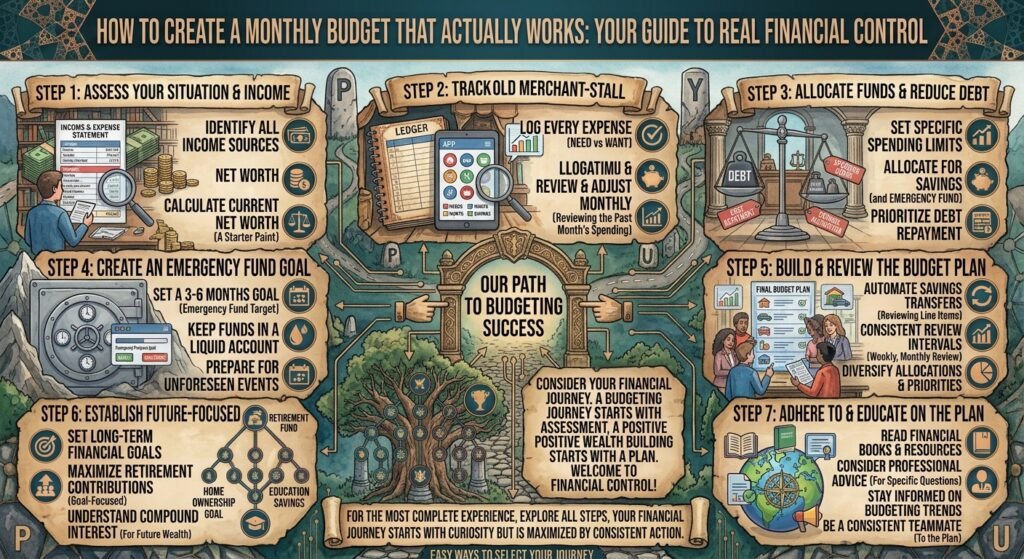
How to Create a Monthly Budget That Actually Works
Creating a monthly budget is one of the most effective ways to take control of your money, reduce financial stress, and work toward your financial goals. Yet, many people create a budget for a few days or weeks and then stop following it. The problem is usually not that budgeting does not work. The problem is that the budget is too complicated, too restrictive, or unrealistic for everyday life.
A successful budget should make your financial life easier rather than making you feel like you cannot spend any money. The purpose of a budget is to give every dollar a purpose while still allowing room for unexpected expenses, entertainment, and the things you enjoy. When you create a realistic monthly budget and consistently review it, you can make better decisions about spending, saving, debt, and investing.
Whether you are living on your first paycheck, trying to pay off debt, saving for a home, or simply wondering where your money goes every month, learning how to create a monthly budget can give you a clear financial roadmap.
In this Monezaro guide, you will learn how to build a monthly budget from scratch, calculate your income, organize expenses, set savings goals, manage irregular costs, avoid common budgeting mistakes, and create a system that you can actually follow.
What Is a Monthly Budget?
A monthly budget is a financial plan that shows how much money you expect to receive during a month and how you plan to use it. Your budget can include housing, groceries, transportation, utilities, insurance, debt payments, savings, investments, entertainment, subscriptions, and other expenses.
A budget is not designed to prevent you from spending money. Instead, it helps you decide where your money should go before you spend it. Without a budget, it is easy for small purchases to accumulate until they consume money that could have been used for savings or debt repayment.
The most effective budget is one that reflects your actual lifestyle and financial situation. There is no universal budget that works perfectly for every person. Someone living in an expensive city may have much higher housing costs than someone living in a smaller town. Similarly, a person with significant debt may need to allocate more money toward debt repayment.
The key is to create a budget that is realistic enough to follow consistently.
1. Calculate Your Monthly Take-Home Income
The first step in creating a monthly budget is determining how much money you actually have available to spend. For most people, the best number to use is take-home pay rather than gross salary. Take-home pay is the money that reaches your bank account after taxes, retirement contributions, insurance premiums, and other payroll deductions.
If you receive a regular paycheck every two weeks, review your pay stubs and determine your typical monthly take-home income. If you receive income from freelancing, commissions, a business, or other sources that fluctuate, you may need to estimate a conservative monthly amount based on your recent income history.
Include reliable sources of income that you can reasonably expect to receive. If part of your income is unpredictable, avoid building your essential budget around your highest possible earnings. Using a conservative estimate can help prevent overspending during months when your income is lower than expected.
Knowing your actual monthly income gives you the foundation for every other budgeting decision.
2. Track Your Spending Before Creating Your Budget
One of the biggest budgeting mistakes is creating a budget based on what you think you spend rather than what you actually spend. Before setting limits, spend some time tracking your expenses.
Review your bank statements, credit card statements, receipts, and payment history. Look at your spending over the previous month or several months if possible. Categorize purchases into areas such as housing, groceries, transportation, dining, entertainment, shopping, subscriptions, debt payments, and savings.
This process can reveal spending patterns that you may not notice during everyday life. You might discover that several small purchases are adding up to a significant amount each month. You may also find recurring subscriptions that you rarely use.
Tracking spending is not about judging yourself. It is about collecting accurate information. Once you know where your money is actually going, you can create a budget based on reality rather than assumptions.
3. Separate Needs From Wants
After tracking your expenses, divide them into needs and wants. Needs are expenses that are essential for your basic lifestyle and financial responsibilities. These may include housing, utilities, groceries, transportation, insurance, minimum debt payments, and other necessary costs.
Wants are expenses that improve your lifestyle but are not essential. These can include restaurant meals, entertainment, streaming services, hobbies, vacations, shopping, and other optional purchases.
This distinction does not mean that wants are bad. Enjoying your money is part of a healthy financial life. The purpose of separating needs and wants is to understand where you have flexibility if your financial situation changes.
For example, if your income decreases unexpectedly, you may not be able to immediately reduce your rent or insurance payment. However, you might be able to temporarily reduce restaurant spending, entertainment, or shopping.
Knowing which expenses are flexible gives your budget more resilience.
4. List All of Your Fixed Monthly Expenses
Fixed expenses are costs that usually remain relatively stable from month to month. Examples include rent or mortgage payments, car payments, insurance premiums, loan payments, and certain subscription services.
Write down each fixed expense and its monthly amount. Having this list helps you understand how much of your income is already committed before you consider flexible spending.
Fixed expenses are important because they determine how much financial flexibility you have. If most of your income is committed to fixed bills, you may have less room for savings and discretionary spending.
When reviewing fixed expenses, look for services or commitments that you no longer need. Canceling an unused subscription or negotiating certain bills may create additional room in your budget.
You do not need to eliminate every recurring expense. The goal is to make sure your fixed expenses are necessary and provide enough value to justify their cost.
5. Estimate Your Variable Expenses
Variable expenses change from month to month. Common examples include groceries, gas, electricity, dining out, entertainment, clothing, personal care, and household purchases.
These expenses can be more difficult to budget because they are not always predictable. Instead of trying to guess an exact number, review your previous spending and calculate a reasonable average.
For example, if you spend different amounts on groceries every week, look at several months of grocery purchases and determine your typical monthly spending. You can then create a reasonable grocery budget rather than choosing an unrealistic number.
Variable expenses are often the easiest place to make adjustments. If you are spending more than planned, you can identify specific categories where reductions are possible.
6. Include Savings as a Monthly Expense
One of the most important changes you can make to your budget is treating savings as a priority rather than something you do only when money is left over.
If you wait until the end of the month to save whatever remains, you may discover that there is nothing left to save. Instead, include savings in your monthly budget from the beginning.
Your savings category might include an emergency fund, short-term goals, retirement contributions, investments, a future home purchase, or other financial objectives.
Even if you can only save a small amount initially, consistency matters. Saving $50 or $100 every month may seem modest, but creating the habit is an important first step.
As your income increases or expenses decrease, you can gradually increase your savings rate.
7. Use the 50/30/20 Rule as a Starting Point
The 50/30/20 budgeting rule is a popular framework that divides after-tax income into three broad categories: approximately 50% for needs, 30% for wants, and 20% for savings and debt repayment.
This approach can be useful for beginners because it provides a simple starting structure. However, you should not treat these percentages as strict requirements.
Your personal situation may require a different approach. If you live in an expensive area, housing and essential expenses may consume more than 50% of your income. If you have aggressive debt repayment goals or want to save for an early retirement, you may choose to allocate more than 20% toward financial goals.
The most important thing is to use the rule as a guideline rather than a restriction.
8. Create Separate Categories for Financial Goals
A budget becomes more motivating when it connects your spending decisions to specific goals. Instead of having one general savings category, consider creating separate goals.
For example, you might have an emergency fund, vacation fund, car replacement fund, home down payment fund, and retirement savings goal.
Specific goals make it easier to understand why you are saving. Instead of thinking, “I am trying not to spend money,” you can think, “I am putting $200 aside this month for my future home.”
Give each goal a target amount and an approximate deadline. Then calculate how much you need to save each month.
Breaking large financial goals into smaller monthly amounts makes them much easier to manage.
9. Budget for Debt Repayment
If you have credit card balances, personal loans, student loans, auto loans, or other debt, debt repayment should be included in your monthly budget.
At a minimum, make sure you can cover all required minimum payments on time. After that, determine whether you can allocate additional money toward your highest-priority debt.
The debt avalanche strategy focuses additional payments on the debt with the highest interest rate. This can reduce the amount of interest paid over time. The debt snowball strategy focuses on the smallest balance first, which can provide a psychological boost as individual balances are eliminated.
Choose a strategy that you can realistically maintain.
As debts are paid off, do not automatically redirect the freed-up money toward lifestyle spending. Consider moving that money into savings or investments instead.
10. Create a Category for Unexpected Expenses
No matter how carefully you plan your budget, unexpected expenses will happen. A vehicle may need repairs, a household appliance may stop working, or you may suddenly need to replace something important.
If your budget has no flexibility for unexpected costs, even a relatively small expense can cause financial stress.
Create a miscellaneous or unexpected-expense category in your monthly budget. This does not replace an emergency fund, but it can help you handle smaller surprises without disrupting your entire financial plan.
Over time, you can also build a larger emergency fund that provides protection against major financial disruptions.
11. Do Not Forget Annual and Irregular Expenses
Many people create a monthly budget but forget about expenses that occur only a few times per year.
Examples can include annual insurance payments, holiday spending, property taxes, professional fees, school expenses, vehicle registration, birthdays, vacations, and home maintenance.
A useful strategy is to convert these expenses into monthly savings targets.
For example, if you expect to spend $1,200 during the holiday season, you could set aside approximately $100 per month throughout the year. When the expense arrives, you already have money available.
This technique is sometimes called a sinking fund. It helps prevent large predictable expenses from becoming financial emergencies.
12. Automate Your Budget
Automation can make your budget much easier to follow. Instead of relying on willpower every month, automate important financial actions whenever possible.
You can set up automatic transfers from your checking account to your savings account. You may also automate investment contributions or bill payments when appropriate.
For example, if you decide to save $200 per month, you can schedule an automatic transfer shortly after receiving your paycheck.
Automation helps turn financial goals into regular habits. It also reduces the temptation to spend money that you intended to save.
13. Give Yourself a Reasonable Fun Budget
A common reason people abandon budgets is that they make them too restrictive. If your plan eliminates every restaurant meal, entertainment purchase, hobby, or social activity, it may become difficult to maintain.
Instead, include a reasonable amount of fun money in your monthly budget.
This category can cover dining out, movies, hobbies, gaming, shopping, entertainment, or other activities you enjoy. Once the money allocated to this category is used, you can wait until the next budget period before spending more.
Giving yourself permission to spend within a defined limit can make your overall financial plan more sustainable.
14. Use a Zero-Based Budget if You Need More Control
A zero-based budget is a system where you assign every dollar of expected income to a specific purpose. The goal is for your income minus planned expenses, savings, debt payments, and investments to equal zero.
This does not mean you literally spend every dollar. Money assigned to savings or investments is still given a purpose.
For example, if your monthly income is $4,000, you might allocate money to housing, groceries, transportation, debt, savings, investments, entertainment, and other categories until the entire $4,000 has a purpose.
This approach can be particularly useful for people who want detailed control over their finances.
15. Choose a Budgeting Method That Fits Your Personality
There is no single best budgeting method for everyone. The best system is the one you can actually maintain.
Some people prefer detailed spreadsheets where every expense is recorded. Others prefer budgeting apps that automatically categorize transactions. Some people use simple envelope-style systems to limit spending in specific categories.
If you enjoy numbers and organization, a detailed spreadsheet may work well. If you prefer simplicity, a basic monthly spending plan may be enough.
Do not choose a complicated budgeting system simply because it appears sophisticated. A simple budget that you follow consistently is usually more useful than a perfect system that you abandon after two weeks.
16. Review Your Budget Every Week
You do not need to wait until the end of the month to discover that you overspent.
A quick weekly review can help you stay on track. Check your bank and credit card transactions and compare your actual spending with your planned amounts.
If you notice that you have already spent too much in one category, you can make adjustments before the month ends.
For example, if you spent more than expected on restaurants during the first two weeks, you might reduce restaurant spending during the remaining weeks and protect your savings goal.
Weekly reviews make budgeting an ongoing process rather than a once-a-month activity.
17. Adjust Your Budget When Your Life Changes
Your budget should change when your circumstances change. A budget created when you were single and renting an apartment may not work after buying a home, getting married, having children, changing jobs, or experiencing a significant change in income.
Review your budget whenever there is a major financial change.
If your income increases, consider directing some of the additional money toward savings, investments, or debt repayment rather than immediately increasing lifestyle expenses.
If your income decreases, identify which expenses can be reduced temporarily and protect your most important financial priorities.
A flexible budget is more likely to survive real-life changes.
18. Avoid Common Budgeting Mistakes
Several common mistakes can make budgeting unnecessarily difficult. One mistake is setting unrealistic spending limits. Another is forgetting irregular expenses. Some people also fail to budget for fun and eventually abandon the plan.
Other mistakes include ignoring small recurring expenses, relying on credit cards to cover budget shortfalls, failing to review spending, and creating too many categories.
The solution is to keep your budget practical. Track important categories, leave room for unexpected costs, and regularly adjust your plan.
Remember that going over budget in one category does not mean the entire budget has failed. You can make adjustments and continue.
19. Use Budgeting to Control Lifestyle Inflation
Lifestyle inflation occurs when your spending increases as your income increases. For example, someone might receive a raise and immediately upgrade their car, move into a more expensive apartment, eat at restaurants more frequently, and increase discretionary spending.
Some lifestyle improvements are perfectly reasonable, but allowing expenses to rise at the same rate as income can prevent you from building wealth.
When your income increases, consider directing part of the additional money toward savings, investing, or debt repayment before increasing your lifestyle expenses.
This approach allows you to enjoy higher income while also improving your long-term financial position.
20. Make Your Monthly Budget a Long-Term Habit
The real power of budgeting comes from consistency. Creating one budget will not transform your finances overnight. The benefits come from repeatedly making intentional decisions about your money.
At the beginning of each month, review your expected income and expenses. During the month, monitor your spending. At the end of the month, evaluate your results and make improvements for the following month.
You will not always stay perfectly within every category. Unexpected expenses happen, income changes, and priorities evolve.
The goal is not perfection. The goal is awareness and control.
When budgeting becomes a normal part of your financial routine, you can make progress toward larger goals such as eliminating debt, building an emergency fund, purchasing a home, investing for retirement, and achieving greater financial independence.
Simple Monthly Budget Example
Here is an example of how a person with $5,000 in monthly take-home income might organize a budget:
- Housing: $1,500
- Utilities: $300
- Groceries: $500
- Transportation: $400
- Insurance: $250
- Debt Payments: $400
- Emergency Savings: $300
- Retirement/Investments: $500
- Entertainment: $250
- Dining Out: $200
- Personal Spending: $200
- Miscellaneous: $200
This is only an example. Your own budget should reflect your actual income, location, household size, debt, financial goals, and lifestyle.
The important principle is that your planned expenses should fit within your available income while leaving room for savings and financial priorities.
Monthly Budget Checklist
Use this checklist when creating your own monthly budget:
- Calculate your take-home income.
- Review your previous month’s spending.
- List fixed expenses.
- Estimate variable expenses.
- Separate needs from wants.
- Add debt payments.
- Set a monthly savings target.
- Include retirement or investment contributions.
- Plan for irregular expenses.
- Create an emergency or miscellaneous category.
- Set a reasonable entertainment budget.
- Automate savings where possible.
- Review your spending every week.
- Adjust the budget when circumstances change.
- Review your financial progress at the end of each month.
Final Thoughts
Learning how to create a monthly budget that actually works is not about restricting every purchase or eliminating everything you enjoy. A successful budget is a practical system that helps you understand your money and make intentional decisions.
Start by calculating your take-home income and tracking where your money goes. Separate essential expenses from optional spending, create realistic limits, and make savings part of your monthly plan. Remember to account for irregular expenses and unexpected costs so that your budget can handle real life.
Most importantly, give yourself flexibility. Your budget does not need to be perfect every month. If you overspend in one category, review what happened, make an adjustment, and continue.
Over time, consistent budgeting can help you reduce financial stress, control unnecessary spending, build emergency savings, pay off debt, and make progress toward long-term financial goals.
At Monezaro, we believe that effective money management starts with understanding the basics and building habits that you can maintain. Your budget is not a punishment for spending money. It is a tool that helps you decide how your money can support the life and financial future you want.
Frequently Asked Questions About Monthly Budgeting
How do I create a monthly budget for the first time?
Start by calculating your monthly take-home income and tracking your current expenses. Then organize your spending into categories such as housing, groceries, transportation, debt, savings, entertainment, and other expenses. Set realistic limits for each category and review your spending throughout the month.
What is the 50/30/20 budget rule?
The 50/30/20 rule is a budgeting framework that suggests allocating approximately 50% of after-tax income to needs, 30% to wants, and 20% to savings and debt repayment. It is a guideline rather than a strict requirement, and you can adjust the percentages based on your financial situation.
How much should I save each month?
The amount you should save depends on your income, expenses, debt, and financial goals. A common budgeting guideline is around 20% of take-home income for savings and debt repayment, but some people may need to start with a smaller amount and gradually increase it.
What should I do if I keep going over my budget?
First, identify which categories are causing the problem. Your budget may be unrealistic, or you may have forgotten certain expenses. Adjust your spending limits based on your actual spending patterns and consider reducing flexible expenses. A budget should be realistic enough that you can follow it consistently.
Should I budget for entertainment?
Yes. Including reasonable entertainment or fun spending can make your budget more sustainable. A budget that completely eliminates enjoyable activities may be difficult to maintain over the long term.
Is a budgeting app better than a spreadsheet?
Neither option is automatically better. A budgeting app can make tracking easier for some people, while a spreadsheet provides more customization and control. The best budgeting method is the one you understand and consistently use.
How often should I review my budget?
A quick weekly review can help you stay on track, while a more detailed review at the end of each month can help you identify patterns and make adjustments. You should also update your budget whenever your income or major expenses change.
Should savings be included in my monthly budget?
Yes. Treating savings as a planned monthly expense can make it more likely that you will consistently save. Automating transfers to savings can make the process even easier.
SEO Information
SEO Title: How to Create a Monthly Budget That Actually Works | Monezaro
Meta Description: Learn how to create a monthly budget that actually works. Discover simple budgeting steps for managing expenses, saving money, paying debt, and reaching financial goals.
Primary Keyword: how to create a monthly budget
Secondary Keywords:
- monthly budget
- how to make a monthly budget
- monthly budgeting
- budgeting for beginners
- how to budget money
- personal budget
- monthly budget plan
- money management
- budgeting tips
- 50/30/20 budget rule
- how to save money
- personal finance tips
Suggested URL Slug:/how-to-create-a-monthly-budget/
Suggested Category: Budgeting
Suggested Tags:
Budgeting, Personal Finance, Money Management, Saving Money, Monthly Budget, Financial Planning, Debt Management
Search Intent: Informational
Target Audience: U.S. adults, beginners, young professionals, families, and anyone who wants to improve monthly money management.
Suggested Internal Links:
- Personal Finance for Beginners: A Complete Guide to Managing Your Money
- How to Save Money Fast: 15 Simple Strategies That Work
- How to Build an Emergency Fund From Scratch
- How to Pay Off Debt Faster: Smart Strategies to Become Debt-Free
- 50/30/20 Budget Rule Explained: How to Manage Your Money Better