
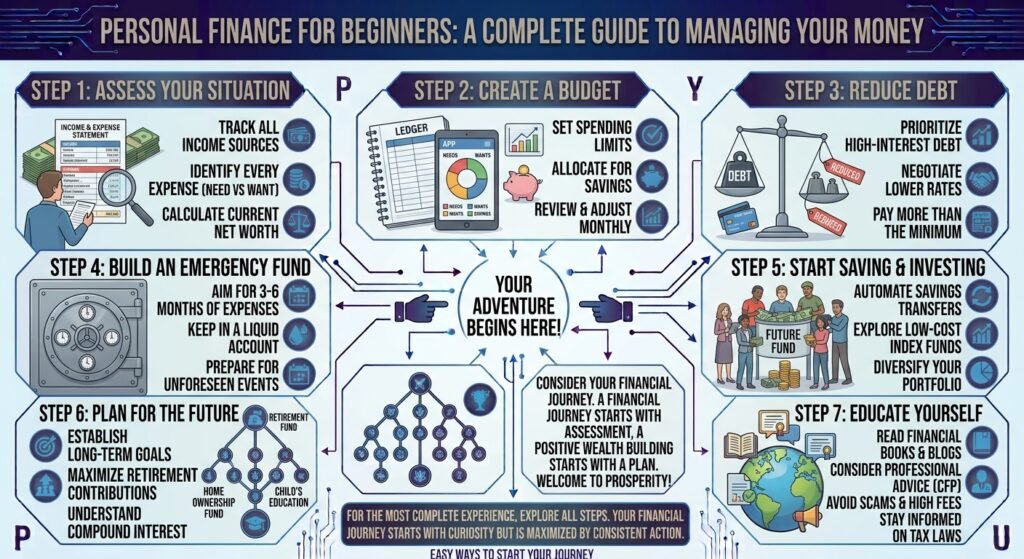
Personal Finance for Beginners: A Complete Guide to Managing Your Money
Managing money effectively is one of the most important skills you can develop for a more secure and comfortable life. Whether you are starting your first job, paying off debt, building savings, or thinking about investing, understanding personal finance can help you make better financial decisions. Unfortunately, many people never receive a practical education about budgeting, saving, credit, investing, taxes, and financial planning. As a result, it is easy to make money mistakes that can become expensive over time.
The good news is that you do not need to be a financial expert to take control of your money. Personal finance is mainly about developing good habits, understanding where your money goes, setting realistic goals, and making informed decisions. Even small improvements can make a meaningful difference when you follow them consistently.
In this complete guide, Monezaro explains the fundamentals of personal finance for beginners, including how to create a budget, build an emergency fund, manage debt, improve credit, start investing, save for retirement, and develop a long-term financial plan.
What Is Personal Finance?
Personal finance refers to the way an individual or household manages money and financial resources. It includes everything from earning income and paying bills to saving money, managing debt, using credit, investing, planning for retirement, and protecting your financial future. Personal finance is not only about how much money you make. It is also about how effectively you manage the money you already have.
For beginners, personal finance can seem complicated because there are many different areas to understand. However, most financial decisions can be organized into a few basic categories: earning, spending, saving, borrowing, investing, and protecting your money. Once you understand these areas, it becomes much easier to make decisions that support your financial goals.
A strong personal finance strategy should be based on your income, expenses, financial responsibilities, and long-term goals. The goal is not necessarily to become wealthy overnight. Instead, the goal is to create financial stability and gradually build wealth through responsible money management.
1. Understand Your Current Financial Situation
Before you create a budget or start investing, you need to understand where you currently stand financially. This means looking at your income, expenses, savings, debts, and financial obligations. Many people avoid reviewing their finances because they are worried about discovering problems, but ignoring your financial situation usually makes those problems harder to solve.
Start by calculating your monthly take-home income. This is the amount that actually reaches your bank account after taxes and other payroll deductions. Then make a list of your regular expenses, including housing, utilities, groceries, transportation, insurance, subscriptions, entertainment, loan payments, and other purchases.
You should also list your current debts and savings. Knowing these numbers gives you a realistic picture of your financial position. Once you understand where you are starting, you can create realistic financial goals instead of making decisions based on assumptions.
2. Create a Realistic Monthly Budget
Creating a monthly budget is one of the most important steps in personal finance for beginners. A budget is simply a plan for how you will use your income. It allows you to decide where your money should go instead of spending first and wondering where the money disappeared later.
Begin by listing your monthly income and all essential expenses. After that, identify discretionary spending such as restaurants, shopping, entertainment, hobbies, and subscriptions. You do not necessarily need to eliminate these expenses. The goal is to understand them and make sure they fit within your financial plan.
A good budget should be realistic. If you create an extremely restrictive budget that does not allow any flexibility, you may struggle to maintain it. Instead, leave some room for entertainment and unexpected expenses while prioritizing savings and important financial goals.
You can use a spreadsheet, budgeting app, banking tool, or simple notebook to track your spending. The specific method is less important than consistently monitoring your money.
3. Follow the 50/30/20 Budgeting Rule
One popular budgeting method for beginners is the 50/30/20 rule. Under this approach, approximately 50% of your after-tax income goes toward needs, 30% toward wants, and 20% toward savings and debt repayment.
Needs generally include essential expenses such as housing, groceries, utilities, transportation, insurance, and minimum debt payments. Wants can include dining out, entertainment, travel, hobbies, subscriptions, and other optional purchases. The final 20% can be directed toward savings, investments, emergency funds, or paying down debt.
The 50/30/20 rule is not a strict financial law. Your personal situation may require different percentages. Someone living in an expensive city may spend more than 50% on essential expenses, while someone with a high income and low expenses may be able to save significantly more than 20%.
The value of this method is that it provides beginners with a simple framework for organizing their money.
4. Build an Emergency Fund
An emergency fund is money set aside for unexpected financial situations. These situations can include job loss, major car repairs, medical expenses, urgent home repairs, or other unexpected bills. Without emergency savings, people often rely on credit cards or loans when something goes wrong.
Start with a small target if you are currently living paycheck to paycheck. Even saving $500 or $1,000 can provide a useful financial cushion. Once you reach that amount, gradually work toward building enough savings to cover several months of essential expenses.
Your emergency fund should generally be kept somewhere safe and accessible rather than invested in assets that can fluctuate significantly in value. A high-yield savings account can be one option to consider for emergency savings because it can provide access to your money while potentially earning interest.
The most important part is consistency. Automating a small transfer from your checking account to savings after each paycheck can make building an emergency fund much easier.
5. Learn How to Manage Debt
Debt is one of the biggest challenges in personal finance. Some forms of debt can help you achieve important goals, such as education or purchasing a home, while high-interest consumer debt can become a major financial burden.
Start by making a complete list of your debts. Include credit cards, personal loans, student loans, auto loans, and other balances. Record the outstanding amount, interest rate, minimum payment, and due date for each debt.
Once you understand your debt, you can choose a repayment strategy. The debt avalanche method focuses on paying the highest-interest debt first while making minimum payments on the others. The debt snowball method focuses on paying the smallest balance first, which can provide psychological motivation as you eliminate individual debts.
Whichever method you choose, avoid taking on unnecessary new debt while you are working toward becoming debt-free.
6. Use Credit Responsibly
Credit can have a major impact on your financial life. A strong credit history can make it easier to qualify for loans, credit cards, rental housing, and potentially more favorable interest rates. Poor credit, on the other hand, can make borrowing more expensive.
One of the most important habits is paying your bills on time. Payment history is an important component of credit scoring, so missed payments can have serious consequences. You should also pay attention to your credit utilization, which represents how much of your available revolving credit you are using.
Avoid treating a credit card as extra income. A credit card should be used as a payment tool, not as a way to spend money you cannot afford to repay. Ideally, pay your credit card balance in full each month when possible to avoid accumulating interest.
Checking your credit reports regularly can also help you identify incorrect information or potential signs of identity theft.
7. Start Saving for Short-Term Goals
Not every financial goal is decades away. You may want to save for a vacation, new vehicle, education, home repairs, a wedding, or a major purchase. Creating separate savings goals can make these objectives easier to manage.
Instead of simply saying, “I need to save more money,” create a specific target. For example, if you want to save $2,400 over 12 months, you know you need to set aside approximately $200 per month.
Breaking large goals into smaller monthly or weekly targets makes them feel more achievable. You can also automate transfers to a dedicated savings account so that the money is moved before you have an opportunity to spend it.
Saving becomes much easier when it is treated as a regular financial obligation rather than whatever money happens to remain at the end of the month.
8. Learn the Difference Between Saving and Investing
Saving and investing are both important, but they serve different purposes. Saving generally involves keeping money in relatively low-risk and accessible accounts. Investing involves putting money into assets such as stocks, bonds, mutual funds, or exchange-traded funds with the expectation that the value may increase over time.
Money you may need soon should generally not be exposed to unnecessary market risk. For example, an emergency fund should prioritize accessibility and stability. Long-term money, however, may have more time to withstand market fluctuations.
Understanding this distinction is essential for beginners. Not every dollar needs to be invested, and not every dollar should remain in cash forever. Your financial goals and timeline should help determine how you divide money between savings and investments.
9. Start Investing for the Long Term
Investing can help you build wealth over many years. You do not necessarily need a large amount of money to begin learning about investing. Many investment platforms allow people to start with relatively small amounts.
For beginners, it is important to understand basic concepts before investing. Learn about diversification, risk, fees, asset allocation, compound growth, and investment time horizons. Avoid making investment decisions simply because something is trending online or because someone promises unusually high returns.
Long-term investing generally requires patience. Markets can rise and fall, and short-term volatility is normal. Instead of attempting to predict every market movement, many investors focus on diversified investments and consistent contributions over time.
Your investment choices should match your financial goals, risk tolerance, and time horizon.
10. Take Advantage of Retirement Accounts
Retirement planning is another important part of personal finance for beginners. The earlier you begin preparing for retirement, the more time your savings potentially have to grow.
In the United States, workers may have access to retirement accounts such as employer-sponsored 401(k) plans or individual retirement accounts (IRAs). Some employers also provide matching contributions, which can add significant value to retirement savings.
If your employer offers a retirement contribution match, understand the terms and consider taking advantage of available benefits when it fits your budget. You should also learn how contributions, taxes, investment choices, and withdrawal rules work before making decisions.
Retirement planning should not be something you start thinking about only when you are close to retirement. Even relatively small contributions made consistently over many years can become meaningful because of compound growth.
11. Understand Compound Interest
Compound interest is one of the most powerful concepts in personal finance. It occurs when your money earns returns and those returns themselves begin generating additional returns.
For example, imagine you invest money and earn a return. Instead of withdrawing the earnings, you leave them invested. Future returns can then be earned on both your original contribution and previous earnings.
This is why starting early can be so valuable. Time allows compounding to work over many years. The exact results will depend on contributions, returns, fees, taxes, and market performance, but the basic principle remains powerful.
Understanding compound growth can also help you recognize why high-interest debt can be so damaging. Just as investments can compound positively, interest on unpaid debt can grow and make balances more difficult to eliminate.
12. Reduce Unnecessary Monthly Expenses
Improving your finances does not always require earning more money. Another approach is to reduce expenses that do not provide meaningful value.
Review your recurring expenses and look for subscriptions, memberships, fees, or services you rarely use. Compare insurance costs periodically, evaluate phone and internet plans, and consider whether frequent restaurant meals or impulse purchases are affecting your budget.
The goal is not to remove every enjoyable expense. Extreme cost-cutting can make a financial plan difficult to maintain. Instead, focus on reducing expenses that do not contribute much to your quality of life.
For example, eliminating several unused subscriptions may save money without significantly changing your lifestyle. Redirecting that money toward debt repayment or savings can gradually improve your financial position.
13. Increase Your Income When Possible
Budgeting and saving are important, but there is a limit to how much you can cut from your expenses. Increasing your income can provide another powerful way to improve your finances.
You might pursue a raise, develop professional skills, change jobs, work overtime when appropriate, freelance, or build a legitimate side income stream. The best option depends on your skills, schedule, career, and personal circumstances.
When your income increases, avoid automatically increasing your lifestyle expenses by the same amount. Instead, consider directing part of the additional income toward savings, investments, or debt repayment.
This approach can help you increase your financial progress without requiring extreme changes to your lifestyle.
14. Set Clear Financial Goals
Financial goals give your money a purpose. Without clear goals, it can be difficult to determine how much you should save, invest, or spend.
Your goals can be divided into short-term, medium-term, and long-term objectives. Short-term goals might include creating an emergency fund or paying off a credit card. Medium-term goals might include buying a vehicle or saving for a home. Long-term goals could include retirement and building wealth.
Make your goals specific and measurable. Instead of saying, “I want to save more,” decide how much you want to save and by what date.
Review your goals regularly and adjust them when your income, expenses, or circumstances change.
15. Protect Your Financial Future
Managing money is not only about saving and investing. You also need to protect what you have built. Insurance can help protect against certain financial risks, while secure account practices can reduce the risk of financial fraud.
Depending on your circumstances, insurance may include health, auto, homeowners or renters, disability, and life insurance. The right coverage depends on your personal situation and financial responsibilities.
You should also use strong passwords, enable multi-factor authentication where available, monitor financial accounts, and be cautious about suspicious emails, calls, and messages.
Financial security involves both building wealth and protecting it.
16. Avoid Common Money Mistakes
Beginners often make financial mistakes because they focus on short-term convenience instead of long-term consequences. Common mistakes include spending more than they earn, relying heavily on credit cards, failing to maintain emergency savings, ignoring high-interest debt, investing without understanding the risks, and not planning for retirement.
Another common mistake is comparing your financial life to other people. Social media can create the impression that everyone else is traveling constantly, buying expensive cars, purchasing large homes, or becoming wealthy quickly. What you see online does not necessarily represent someone’s complete financial situation.
Focus on your own income, expenses, goals, and progress. Personal finance is personal, and the strategy that works for someone else may not be appropriate for you.
17. Automate Your Finances
Automation can make good financial habits much easier to maintain. Instead of manually transferring money every month, you can set up automatic transfers for savings or investment contributions.
You can also automate bill payments when appropriate. This can reduce the risk of forgetting due dates and potentially incurring late fees.
A simple automated system might direct part of each paycheck toward essential expenses, savings, investments, and debt repayment. The exact percentages should reflect your personal situation.
Automation is especially useful because it reduces the need to rely on motivation. Once your financial system is established, good habits can happen automatically.
18. Review Your Finances Every Month
Your financial plan should not be created once and forgotten. Review your finances regularly to determine what is working and what needs improvement.
At the end of each month, look at your income, spending, savings, debt balances, and progress toward your goals. Ask yourself whether you stayed within your budget and whether there were unexpected expenses.
Monthly reviews can help you identify patterns. Perhaps you are spending more on food than expected, paying for subscriptions you do not use, or consistently saving less than planned.
The purpose of a financial review is not to criticize yourself. It is to gather information and make better decisions during the following month.
19. Build Financial Habits That Last
The biggest improvement in personal finance usually comes from consistency rather than one dramatic decision. Saving $50 every month, making debt payments on time, investing regularly, and tracking expenses may seem small individually, but these habits can produce meaningful results over years.
Start with a few manageable habits instead of trying to change everything at once. For example, you might begin by tracking your spending, creating an emergency fund, and paying your credit card balance on time.
Once these habits become normal, add another goal. Over time, your financial system can become stronger without feeling overwhelming.
Remember that financial progress is rarely perfectly linear. Unexpected expenses and life changes happen. What matters is returning to your plan and continuing to move forward.
20. Create a Long-Term Financial Plan
A long-term financial plan brings everything together. It should consider your income, spending, savings, debt, investments, insurance, retirement, and major future goals.
Start by identifying where you want to be financially in one year, five years, and beyond. Then determine what actions can help you move toward those goals.
For example, your first year might focus on building an emergency fund and eliminating high-interest debt. The following years might focus more heavily on investing, retirement savings, and other long-term goals.
Your financial plan should change as your life changes. A new job, marriage, children, home purchase, business, or major change in income can require you to update your strategy.
The goal is not to create a perfect plan. The goal is to create a useful plan that helps you make better decisions consistently.
Personal Finance Checklist for Beginners
If you are just starting your financial journey, use this simple checklist:
- Calculate your monthly take-home income.
- Track your spending for at least one month.
- Create a realistic monthly budget.
- Separate needs from wants.
- Start an emergency fund.
- Make a list of all debts.
- Prioritize high-interest debt.
- Pay bills on time.
- Monitor your credit.
- Set short-term and long-term financial goals.
- Start saving automatically.
- Learn the basics of investing.
- Consider retirement savings.
- Review recurring expenses.
- Look for ways to increase your income.
- Protect your finances with appropriate insurance and account security.
- Review your financial progress every month.
Final Thoughts
Learning personal finance does not have to be complicated. The most important step is simply getting started. When you understand your income, control your spending, build savings, manage debt, use credit responsibly, and invest for the long term, you create a stronger foundation for your financial future.
The key is consistency. You do not need to save thousands of dollars immediately or become an investment expert overnight. Start with simple actions that you can maintain. Create a budget, build an emergency fund, pay down expensive debt, and gradually learn more about investing and retirement planning.
Your financial situation can improve significantly when small, responsible decisions become long-term habits. At Monezaro, the goal is to make financial education easier to understand so beginners can make more informed decisions about their money.
Remember, personal finance is not about being perfect. It is about understanding your choices, planning ahead, learning from mistakes, and consistently working toward greater financial stability and independence.
Frequently Asked Questions About Personal Finance
What is personal finance for beginners?
Personal finance for beginners is the process of learning how to manage income, expenses, savings, debt, credit, investments, and financial goals. It provides the foundation needed to make responsible financial decisions and build long-term financial stability.
How should I start managing my money?
Start by understanding your income and expenses. Track your spending, create a realistic monthly budget, build an emergency fund, manage high-interest debt, and establish clear financial goals. Once these basics are in place, you can begin focusing more heavily on investing and long-term wealth building.
How much money should I save each month?
There is no single amount that works for everyone. Your savings target depends on your income, expenses, debt, and financial goals. A commonly used budgeting guideline is to direct around 20% of income toward savings and debt repayment, but your actual percentage may need to be higher or lower.
Why is an emergency fund important?
An emergency fund provides financial protection when unexpected expenses occur. It can help you handle events such as job loss, major repairs, or unexpected bills without relying entirely on credit cards or high-interest loans.
Should I pay off debt before investing?
The answer depends on the type and interest rate of your debt, your financial goals, and whether you have an emergency fund. High-interest debt can be particularly expensive, so paying it down can be an important priority. At the same time, some people may benefit from taking advantage of employer retirement contributions while also reducing debt.
How can I improve my credit score?
Paying bills on time, managing credit responsibly, keeping credit utilization under control, monitoring your credit reports, and avoiding unnecessary applications for new credit can support healthy credit habits over time.
Is investing important for personal finance?
Investing can be an important part of long-term financial planning because it provides an opportunity for your money to grow over time. However, investments involve risk, and beginners should understand the investment, its fees, risks, and time horizon before committing money.
What is the best financial habit for beginners?
One of the most valuable habits is consistently spending less than you earn while directing some of your income toward savings, debt repayment, and long-term goals. Tracking your money and automating savings can make this habit easier to maintain.
SEO Information
SEO Title: Personal Finance for Beginners: Complete Money Management Guide
Meta Description: Learn personal finance for beginners with this complete guide to budgeting, saving, debt, credit, investing, emergency funds, and building long-term financial stability.
Primary Keyword: personal finance for beginners
Secondary Keywords:
- personal finance
- money management
- how to manage money
- personal finance tips
- budgeting for beginners
- saving money
- emergency fund
- debt management
- investing for beginners
- financial planning
- money management tips
- how to budget money
Suggested URL Slug:/personal-finance-for-beginners/
Suggested Category: Personal Finance
Suggested Tags:
Personal Finance, Money Management, Budgeting, Saving Money, Investing, Debt Management, Financial Planning, Credit
Search Intent: Informational
Target Audience: Beginners looking to improve their personal finances, budgeting, saving, credit, debt management, and investing knowledge.